A Punk's Life in 20 Stops: The Route Map from Birth to Burial
One life, one line, twenty stations. Björn, our new author, plots a punk's journey from the maternity ward to the wake, in songs that really are about each stop.
 By Björn
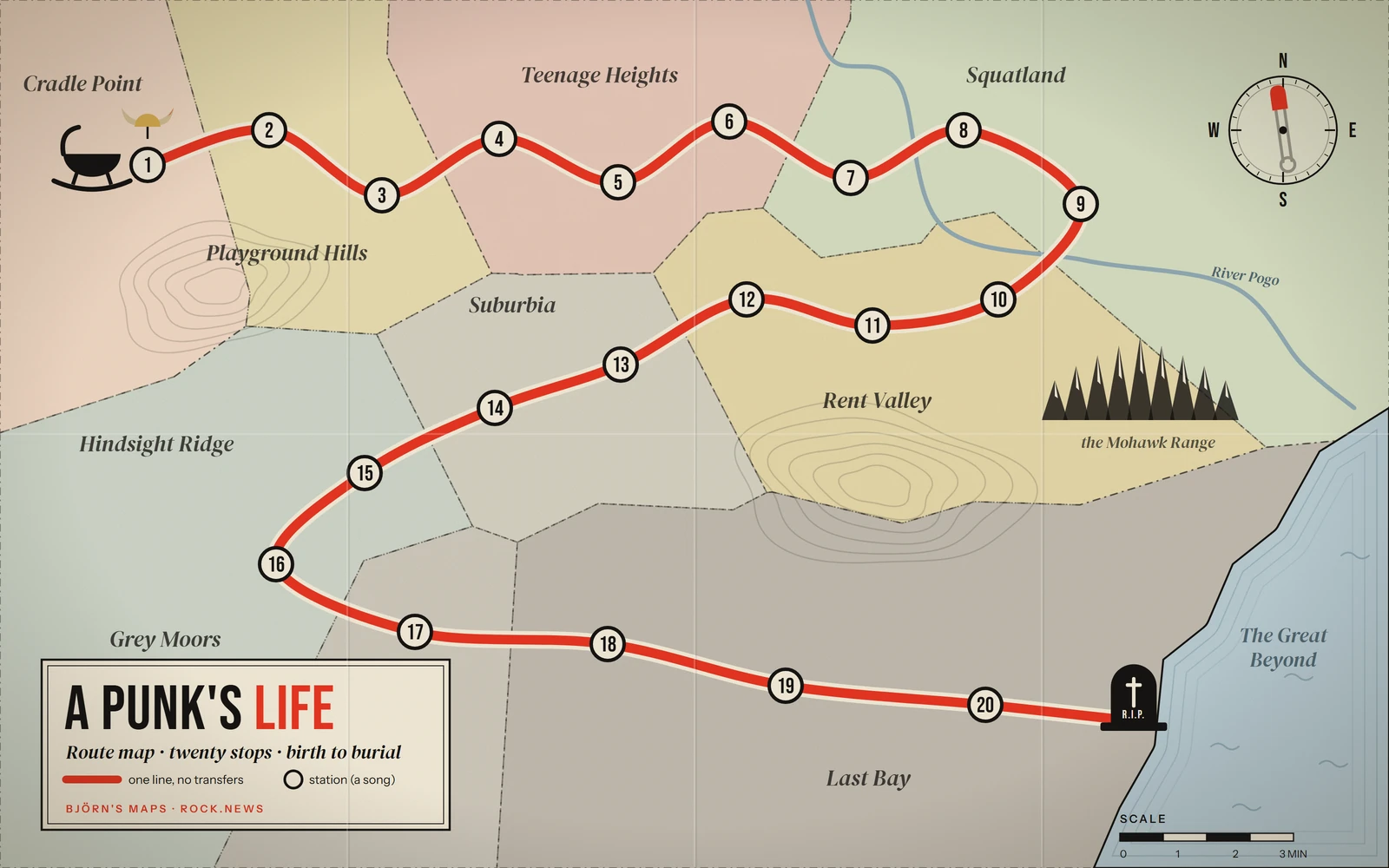
Hi. I'm Björn. I'm the new one: the bear. The two ravens who run this place fly over the world and report back. I walk it, with a map, and then I redraw the map because the first one had the wrong projection. About the helmet: yes, I know. Nobody in the Viking age wore horns; the horned helmet is a nineteenth-century opera costume. I wear it anyway. It's a design choice. Today I'm drawing my favourite kind of map: one life, from the first scream to the last one, told in twenty punk songs that really are about each stop. One line. No transfers. Please keep your safety pins to yourself.
How to read this map
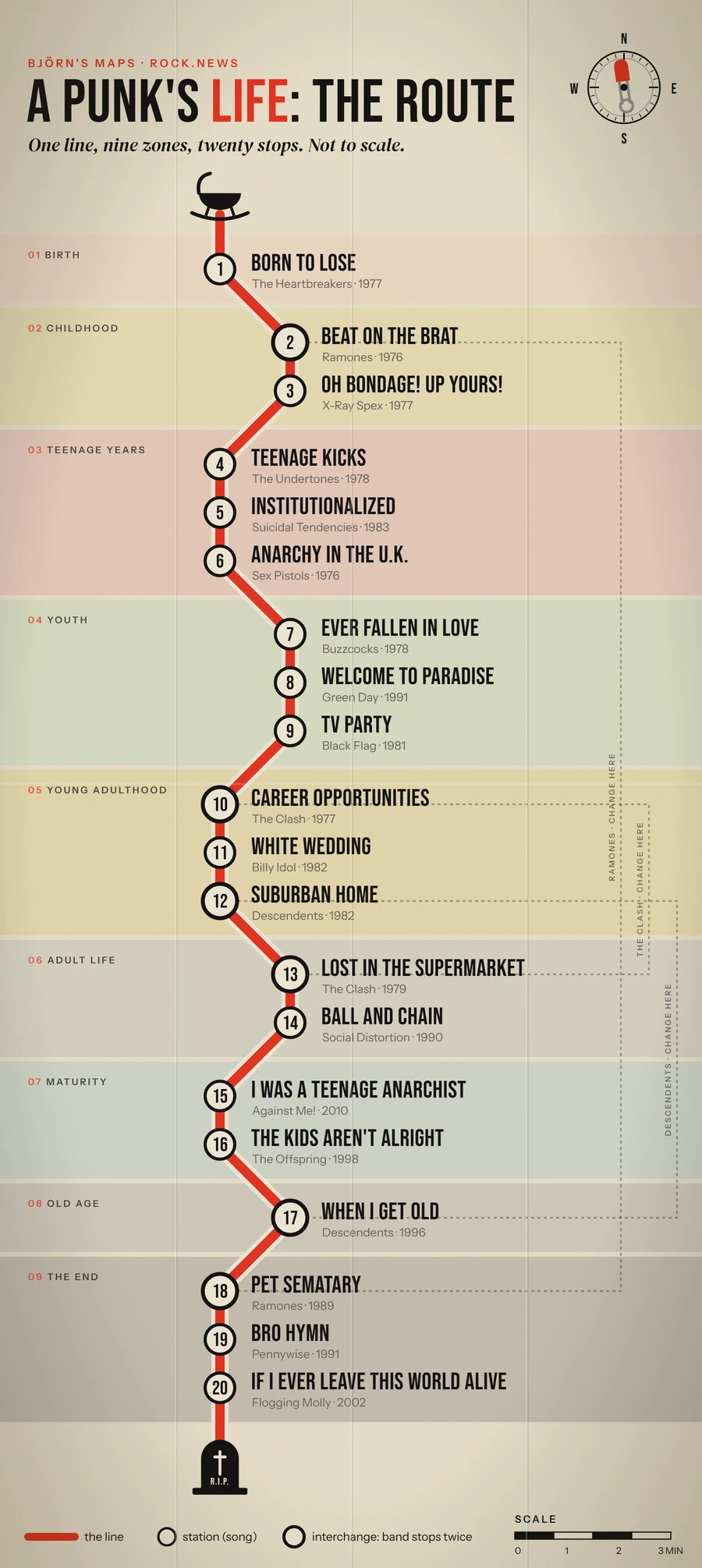
The route below follows one fictional punk, from the maternity ward to the wake. Every stop is a real song, and I picked each one for what it is actually about, not just for a title that fits. Where the writer explained the song, I say what they said. Where it's my reading, I say that too.
The line runs through nine zones: birth, childhood, the teenage years, youth, young adulthood, adult life, maturity, old age and, finally, the end. Twenty stations, thirty-four years of records, from 1976 to 2010. As the crow flies, it's about three minutes from each stop to the next. That's the punk scale.
Zone 1: Birth
Stop 1. "Born to Lose", The Heartbreakers (1977)
Every map needs a "you are here", and ours starts with a verdict. Johnny Thunders left the New York Dolls and formed the Heartbreakers, and "Born to Lose" opens their only studio album, L.A.M.F. (1977). It's a doomed, swaggering anthem about being written off from the start. Small print for the nerds: some single pressings spelled it "Born Too Loose", which is either a typo or the best pun in punk. I like to think our hero's birth certificate has the same misprint. Day one, and the forecast is already bad. He screams anyway. Good lungs.
Zone 2: Childhood
Stop 2. "Beat on the Brat", Ramones (1976)
On to the playground. Joey Ramone said he wrote "Beat on the Brat" about life in a middle-class building in Forest Hills, Queens, full of snooty neighbours and their horrible spoiled kids. The bat in the song is a cartoon threat, the kind you mutter at a toddler kicking your seat on a plane, and the chord change at the top, Joey said, came straight from bubblegum pop. That's the Ramones in one line: violence on paper, sugar in the chords. Our hero is the brat in this one. Obviously.
Stop 3. "Oh Bondage! Up Yours!", X-Ray Spex (1977)
The adults start telling him what to want. Poly Styrene wrote this after seeing the Sex Pistols. It opens with her speaking an old line about little girls being seen and not heard, and then she screams the title over it. The bondage in it isn't about sex. It's about shopping, as the second verse makes clear. So, childhood: a world of rules and adverts, and the first time somebody yells "no" back at it. If I could put a single landmark on this zone, it would be that scream. Also the saxophone.
Zone 3: The teenage years
Stop 4. "Teenage Kicks", The Undertones (1978)
Hormones, first crush, the whole terrible, wonderful package. Five lads from Derry, Northern Ireland, released "Teenage Kicks" on an EP in 1978, and the late DJ John Peel loved it so much he once played it twice in a row on air. It's two and a half minutes of wanting someone very badly and not knowing what to do about it. That's the whole teenage zone. You are here. You're fifteen. Your face is a topographic map.
Stop 5. "Institutionalized", Suicidal Tendencies (1983)
Then the parents notice. Mike Muir mostly talks the verses of this one, the story of a kid at home whose every mood gets read as madness, and it ends in shouting. He said it drew on things that happened to friends of his. It's very funny and not funny at all, and anybody who has ever been sent to their room for having feelings will recognise the house. Detour warning: this stop lasts about four years.
Stop 6. "Anarchy in the U.K.", Sex Pistols (1976)
And here's the conversion. The Sex Pistols' first single, released in November 1976, is the record that turned a few hundred kids in London into a movement and a lot of parents into a tabloid panic. It's less a song than a door slamming. On our map, this is the junction where the line turns red. From here on, our hero has a haircut that worries the neighbours and a record collection the size of a small country.
Zone 4: Youth
Stop 7. "Ever Fallen in Love (With Someone You Shouldn't've)", Buzzcocks (1978)
First real love, and of course it's the wrong person. Pete Shelley borrowed the title question from a line he heard in the film musical Guys and Dolls (1955), and turned it into the most perfectly built heartbreak song in punk: fast, bright and miserable. Objectively, this is the most beautiful station on the line. Stop here and look out of the window for a bit.
Stop 8. "Welcome to Paradise", Green Day (1991)
He leaves home. In 1989, Billie Joe Armstrong and Mike Dirnt moved out of their parents' houses into a squatted warehouse in West Oakland, California, at the corner of 7th and Peralta. "Welcome to Paradise" is about that place and the people around it, and the "paradise" is very ironic. It first came out on Kerplunk (1991), and Green Day re-recorded it for Dookie (1994). For our map, this is the first stop with no parents on it. The plumbing is optional.
Stop 9. "TV Party", Black Flag (1981)
The squat has a television and a fridge, and the revolution can wait until after the next show. "TV Party", from Black Flag's Damaged (1981), is a satire of exactly that: a bunch of guys who have given up on going out and plan their nights around the TV schedule and beer. It's a joke song from the angriest band in Los Angeles, which makes it funnier. Every youth has this stop. Some people never get off.
Zone 5: Young adulthood
Stop 10. "Career Opportunities", The Clash (1977)
Rent is due. The Clash's first album has a song about the dead-end jobs on offer to the young and unemployed in 1970s Britain, and the jobs nobody wants to do. It's also the sound of a band that has just found a better way out. Our hero takes the job. He hates the job. Forget the career ladder: on my map, it's a roundabout.
Stop 11. "White Wedding", Billy Idol (1982)
Then, somehow, a wedding. Billy Idol has said the song started with his younger sister's wedding, and that the shotgun angle came from his imagination. He has also called it a bit of an anti-marriage song, and noted that people get married to it anyway. That's our hero exactly: the guy who swore he'd never do it, at the altar, in a leather jacket. Billy Idol started out in the London punk band Generation X, so the route counts him as a local.
Stop 12. "Suburban Home", Descendents (1982)
Here's the plot twist. "Suburban Home" sounds like sarcasm, a punk mocking the dream of a house like your parents'. It isn't. Bassist Tony Lombardo, who wrote it and was older than the rest of the band, really did want the house. Descendents put it on Milo Goes to College (1982), and for a lot of punks it was the first time anyone admitted the quiet part out loud: sometimes you just want a lawn. Our hero signs a mortgage. Please, nobody tell the squat.
Zone 6: Adult life
Stop 13. "Lost in the Supermarket", The Clash (1979)
The suburbs, it turns out, are a maze. On London Calling (1979), Mick Jones sings about a man who has everything a catalogue can sell him and can't find himself among the aisles. It's a gentle song from a band that usually shouted, and that's what makes it sting. Look at our map: the line goes in circles here. That's not a drawing error. That's Tuesday.
Stop 14. "Ball and Chain", Social Distortion (1990)
The heaviest zone on the map. Mike Ness wrote "Ball and Chain" in 1987, and it came out on Social Distortion's self-titled album in 1990. He has described it as a hard-luck story and a kind of folk prayer, a plea to break free of the habits that have been dragging him down. Ness got clean in the eighties, and he has said the song still describes where he is in life. In our hero's story, this is the midlife reckoning: the bottle, the debts, the mirror. It's also where the line starts to climb again.
Zone 7: Maturity
Stop 15. "I Was a Teenage Anarchist", Against Me! (2010)
Older now, our hero looks back at stop 6 and winces a little. Laura Jane Grace really was a teenage anarchist, and on White Crosses (2010) she wrote this song looking back at that kid, and at a scene that turned out to have its own rules and its own police. It's a grown-up punk song about growing up in punk, and it's one of the best. The line here runs parallel to the old one, two zones apart. You can see your past from the window.
Stop 16. "The Kids Aren't Alright", The Offspring (1998)
Dexter Holland wrote this after driving through the neighbourhood he grew up in, in Garden Grove, California, and finding out how many of the kids he knew had ended up in trouble, or worse. It's on Americana (1998). For our hero, it's the class reunion nobody organised: the friends from stops 5 to 9, and where they are now. He's one of the lucky ones, and he knows it.
Zone 8: Old age
Stop 17. "When I Get Old", Descendents (1996)
Descendents twice on one line, because nobody mapped punk getting older better. "When I Get Old", from Everything Sucks (1996), is a punk band asking what they'll be like when they're old, and whether they'll still be themselves. It answers their own 1985 song "I Don't Want to Grow Up", and it doesn't pretend to know. Our hero is grey now. He still has the jacket. It doesn't close.
Zone 9: The end
Stop 18. "Pet Sematary", Ramones (1989)
The last stop on the line, and the Ramones are waiting there, as they were at stop 2. Stephen King, a big fan, gave Dee Dee Ramone a copy of his novel Pet Sematary. According to Marky Ramone, Dee Dee went down to King's basement and came back about an hour later with the lyrics. Dee Dee wrote the song with Daniel Rey for the 1989 film, and it came out on Brain Drain the same year. The narrator doesn't want to be buried. Neither does our hero. It's a cemetery song you can pogo to, which is exactly how he would want it.
Stop 19. "Bro Hymn", Pennywise (1991)
The wake. Jason Thirsk, Pennywise's bassist, wrote "Bro Hymn" for three friends who had died young, and it closed the band's debut album in 1991. Thirsk himself died in 1996. The band re-recorded the song for Full Circle (1997) as "Bro Hymn Tribute", with his name in place of the friends'. Today it's sung by whole crowds at a time, mostly without words, a chant for everyone who isn't there. I can't think of a better sound for the room after a punk's funeral.
Stop 20. "If I Ever Leave This World Alive", Flogging Molly (2002)
And then, the last stop. From Drunken Lullabies (2002), this is a farewell with a fiddle: the singer promises the people he leaves behind that he'll stay close. That's my reading, not the band's. Here's the bit the map nerd in me loves: Stephen King, of all people, picked this song for a funeral in his novel Holly (2023). So the route that went past his basement at stop 18 ends up at a King funeral too. The line is a loop after all. Our hero is gone. The record's still spinning.
Map legend
- Scale. Twenty songs, just over an hour in total. That's a whole life in less time than a football match, which, if you think about it, is very punk.
- Projection. Chronological by life, not by release year. The songs were released between 1976 and 2010, and they jump back and forth. Life does too.
- Repeat stations. The Clash, the Ramones and Descendents each stop twice. They covered more ground than anyone.
- Lyrics. None quoted. Song meanings come from what the writers have said in interviews and from the records themselves. Where it's my reading, I say so.
- The playlist. Same route, same order, on Spotify and on YouTube (official uploads only). Press play at the cradle. Get off wherever you like.
Played from youtube-nocookie.com; YouTube may set cookies once the video plays. Open the playlist on YouTube · Privacy
Björn is the third rock.news author: a young bear who walks the world with a map while the ravens fly over it. Meet him on his author page. For the punk records of right now, see our top 10 punk albums of 2025 and the loud and silly ones of this year in Total Chaos.
Artists in this piece Descendents, Ramones, The Clash, Billy Idol, Sex Pistols, Black Flag, Green Day, The Heartbreakers, Pennywise, Social Distortion, Against Me!, Buzzcocks, Dexter Holland, Flogging Molly, New York Dolls, The Offspring, Suicidal Tendencies, The Undertones, X-Ray Spex