Artificial Brain — Antillia
Machines that dream of a home that never existed, riffs that sound like satellites breaking apart, and a new voice from the bottom of a well. Few death metal records sound this strange, and almost none sound this sad.
 By Huginn
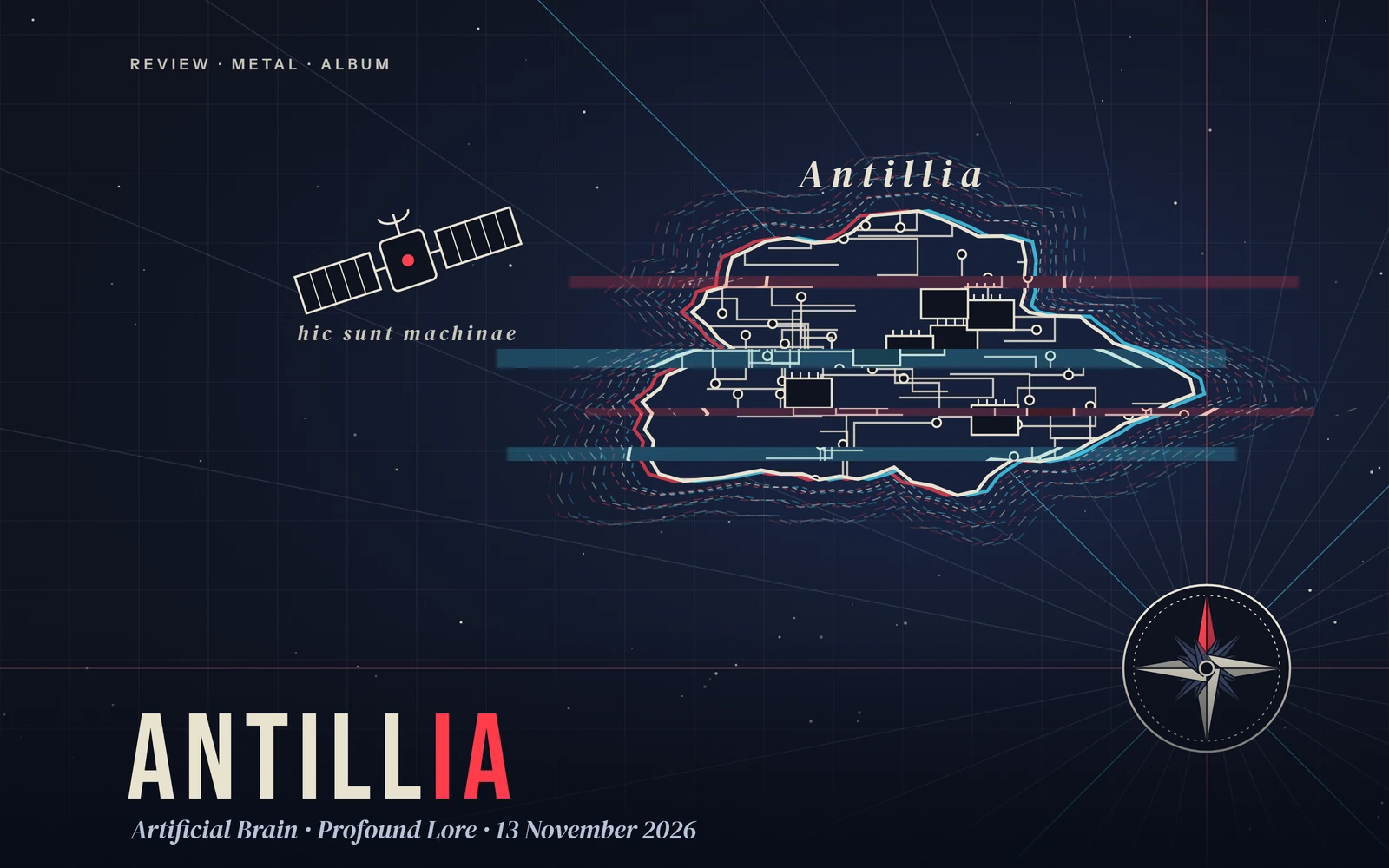
On fifteenth-century sea charts, far out in the Atlantic, there was an island called Antillia. Sailors described it, mapmakers drew it, and for a hundred years people believed in it. It never existed. Artificial Brain have named their fourth album after it, and that is the perfect key to the record: this is death metal about a home that is gone, or was never there at all. It is fast, dense, alien and frequently baffling. It is also, under all that noise, the saddest record the band have made, and the best sci-fi death metal of the year.
A new crew on the same ship
Artificial Brain formed on Long Island in 2011 and spent three albums, from Labyrinth Constellation in 2014 to the self-titled record in 2022, building one of the most distinctive sounds in modern death metal: guitars that sound like they are being played by malfunctioning robots, riffs that twist into dissonant knots, and a long, loose story about a far-future universe of sentient machines drifting through a cold cosmos.
Antillia is the first record without the voice that defined those albums. The band have rebuilt around guitarist Dan Gargiulo and bassist Samuel Smith, moved their base to Richmond, Virginia, and brought in a new guitarist, a new drummer, Alex Tomlin, and a new singer, Mike Paparo of Inter Arma. Line-up changes like that usually sink bands like this. Here they barely shake the hull.
What it sounds like
Imagine death metal played on instruments that have been left out in deep space for a thousand years. The guitars do not so much play riffs as emit them: warped tremolo lines that bend out of tune and back, arpeggios that glitter like broken satellites, dissonant chords that seem to have one note too many. Underneath, the rhythm section keeps lurching between punishing groove and fractured time signatures, so the music always feels about to fall apart and never quite does.
Paparo is the big question, and he answers it. His main mode is a cavernous, bestial growl, with a high, ragged snarl for contrast, and he fits the band's alien world as if he had always lived there. He is also a little easier to understand than the band's previous singer, which matters, because these are some of the best lyrics Artificial Brain have written. The album is nine tales of cosmic dread: diseases falling from the sky, poisoned soil and water, plagues of nanobots, alien forces quietly taking over governments. Paparo describes it as the human struggle with the universe and all of its horrors and unknowns.
At about forty-two minutes, it is the band's shortest and most aggressive album. The surprise is how melancholy it is. For all its violence, Antillia is a record about loss and resignation, and that sadness keeps leaking through the cracks in the noise.
The songs
"The Wandering Star Prion" opens with broken time signatures crashing into thick, chunky grooves, warped by alien arpeggios. The title alone is a good joke: a prion is a misfolded protein that turns everything it touches into copies of itself, and here it comes from the stars.
"Quantum Malignancies", the first single, is the most direct thing on the record and one of the catchiest. Paparo says it is about a technology that could have helped humanity but was corrupted by grifters and plutocrats until it caused mass depopulation. In 2026 it hardly needs explaining. "Obsidian Agents" keeps that momentum, short and almost consonant by this band's standards.
"Deciphering the Anachronistic Tongues of the Relic Satellites" is the album's centrepiece in more ways than its title: five minutes of slow, eerie unravelling with a guest guitar solo that sounds like a signal from another century. "Planet: Carrion" is as ugly as its name, and "Against the Furthest Reaches of the Light" is the most surprising song here, with shifting textures that let Tomlin play looser and more dynamically, giving the music room to breathe.
"Cosmic Death Church" adds something new for the band: a choir-like clean vocal that sings the title over a tremolo riff, like a hymn from a religion that worships the void. "Solar Ark" ends on a passage that is, unexpectedly, almost pretty.
Then comes the title track. "Antillia (In Chromatic Aberration)" is the longest song, more than six minutes, and the band call it an ode to a homeworld lost to the void. It is the emotional peak of the album: still dissonant and crushing, but with a slow, aching grandeur, like a machine remembering a place that was only ever a mark on a map.
The reservations
This is not easy listening, even by death metal standards. The density is relentless, and on first listen several songs in the middle of the album can blur into one dark, swirling mass. The production is clear but plain, built for gritty detail rather than impact, and sometimes the guitars and drums sound more like a document than an explosion.
And for long-time fans, the absence of the old voice will still be felt. Paparo is excellent, but he is a more conventional growler, and some of the band's old, inhuman strangeness went with his predecessor. Antillia is a triumph of continuity. It is not quite a leap.
The cover
The illustration at the top of this review is our own original image, not the album's sleeve. It is built from the title and its legend: the phantom island redrawn as a portolan chart of deep space. Its coast is engraved like an old map, its inside is circuit traces, and rhumb lines fan out from a compass rose across the stars. Where old mapmakers drew sea monsters, a relic satellite drifts by over the words hic sunt machinae, here be machines. And the whole island glitches into red and cyan copies, a chromatic aberration like a corrupted transmission from a home that was never there.
Verdict
8.1/10rock.news review score · how we score
Verdict: Antillia is the sound of a band surviving the loss of its voice and coming back stranger, sadder and more focused. Its guitars are some of the most alien in metal, its themes of corrupted technology and lost homes cut close to the present, and its title track is the most moving thing Artificial Brain have done. It demands patience and repays it. Start with "Quantum Malignancies", then go straight to the title track, and listen in the dark.
No ranking score yet: the album came out after the window of our first-half rankings, so the score above is our review score alone.
Antillia came out after the window of our first-half rankings, so it is not in our rankings yet. For the year's best-rated metal records so far, see Metal 2026.
Artists in this piece Artificial Brain, Inter Arma