Enslaved — Mið
Thirty-five years in, the Norwegian band walk into the studio without finished songs, reach back to the riffs of their youth and come out with their most direct record in years.
 By Huginn
Enslaved have spent three decades travelling outward, from Viking-age black metal into long, keyboard-lit progressive epics. Mið is the sound of them coming back to the centre. It is their seventeenth album, their shortest in a while, and one of their most alive.
Back to the middle
Mið is an Old Norse word for the centre, the middle. The band frame the record around that idea: the axis, the origin, the present moment. In practice it means something very simple. For the first time in their career, Enslaved went into the studio without a stack of finished material and composed and arranged much of the album on the spot, according to Last Rites. The press materials named an unexpected touchstone: Bathory's Blood Fire Death, the 1988 album that taught a generation of Norwegians that black metal could be epic. Several members of Enslaved had recently played that record in full as a tribute act at the Hell's Heroes festival.
You can hear both facts all over Mið. The riffs are simpler, rawer and more insistent than anything on Heimdal (2023). Last Rites heard unruly tremolo on the lower strings and chromatic slides that point straight back to Quorthon, and called it an exceptionally endearing album that sounds like nothing else in the band's catalogue. At around 42 minutes and eight tracks, it is also lean in a way their recent records were not.
The band
The line-up is the one that has carried the band through the last several records: founders Ivar Bjørnson on guitar and Grutle Kjellson on vocals and bass, Arve "Ice Dale" Isdal on guitar, Håkon Vinje on keyboards and clean vocals, and Iver Sandøy on drums. Vinje has quietly become one of the band's secret weapons. Heavy Music HQ singled out his keyboard solo on "I Am Ice" and compared it to the great 1970s progressive rock keyboard players, and it is the kind of flourish that keeps the back-to-basics riffing from sounding like nostalgia.
Two guest voices, one sky
The most striking thing on Mið is not a riff. It is the two guests. Johan Sara Jr., a Norwegian Sámi musician, appears on "I Am Ice". Kevin Kicking Woman, an educator and elder of the Blackfeet Nation, sings on "Spirit Helper". Last Rites called "Spirit Helper" the album's highlight and praised the "gobsmacking synergy" between Indigenous music and black metal. Distorted Sound described its chant-like, hypnotic quality as unlike anything the band has done before.
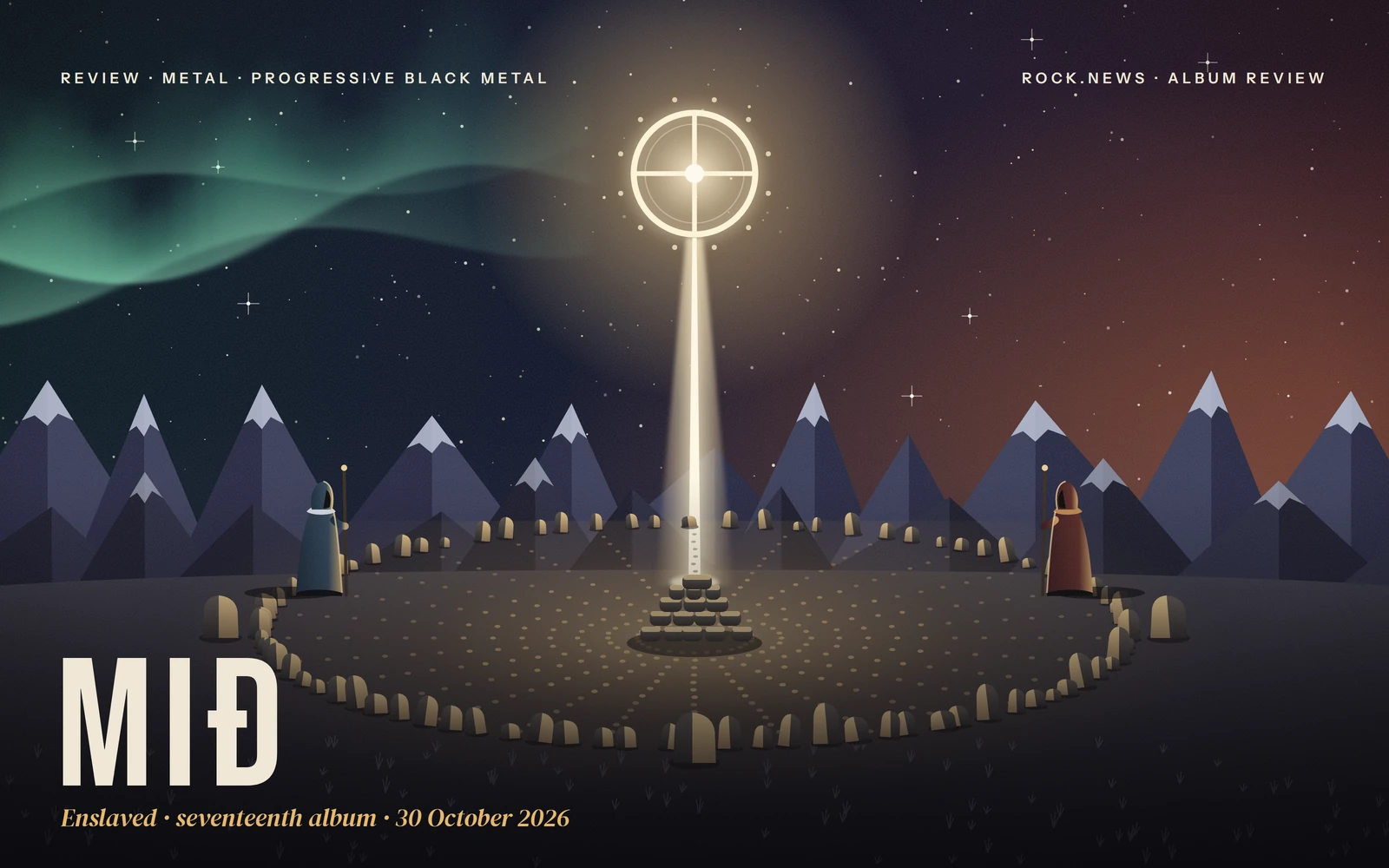
The cover art by Truls Espedal makes the same argument visually. It combines the Medicine Wheel in Wyoming with the Hunnfelt, a Bronze Age rock carving site in southeast Norway: two sacred places thousands of kilometres apart, under the same sky. Last Rites read the record as presenting black metal as something older than civilisation itself, a universal music of humanity's wild origins. That is a big claim for a heavy metal album. Mið mostly earns it.
The tracks
- "Non-Being" opens the record and, as Distorted Sound put it, starts the journey.
- "I Am Ice" is the real opener. Its first black metal riff arrives at around 35 seconds, and Last Rites heard a Bathory-worshipping breakdown at the 2:20 mark. Distorted Sound called it formidable and anthemic. Johan Sara Jr.'s contribution and Vinje's solo make it the album's most colourful song.
- "Solar Will", the first single, is built on what Last Rites called a basic, catchy and "absolutely perfect" main riff. Bjørnson describes the Sun in it as "a nurturing and terrifying parent", and Kjellson has said the lyric depicts a rivalry from Norse myth without naming the figures, leaving the listener to work it out.
- "Mountain" begins in harmony and then breaks into a hard, swinging groove. Distorted Sound thought it would work brilliantly live; Last Rites found its breakdown a little out of character.
- "Spirit Helper" is the heart of the record, as above.
- "Parting" brings the aggression back, built around a forceful open-string riff. Nine Circles highlighted it and called the album's production among the best-sounding in the band's catalogue.
- "Tales of Trees", another single, is pulverising but majestic, in Distorted Sound's words.
- "I Miðju", "in the middle", closes the album in seven sombre minutes.
The reservations
The critics who liked Mið least agree on where it sags. Angry Metal Guy gave it 3.0 out of 5 and found some of the songs too long. Last Rites, for all its enthusiasm, said the closing "I Miðju" adds length but not depth and should have been trimmed. The Progressive Subway called the album excellent but admitted it took repeated listens to win them over, and had doubts about the opener and the outro of "I Am Ice". The simpler, rawer approach is the record's strength, and in a couple of places it is also a limit: a riff that is perfect in four minutes is less so in seven.
At the other end, Sonic Perspectives gave it 9.3 and called it the band's best record in a decade. The truth sits between: a very good Enslaved album, and the most purely enjoyable one in some time.
Verdict
8.0/10rock.news review score · how we score
Verdict: Mið is Enslaved going back to the centre and finding it still burning. Written largely in the room, built on riffs that owe more to Bathory than to prog, and opened up by two remarkable guest voices from the far north and the American West, it is their most direct and generous record in years. It is not flawless, and the closer overstays, but it sounds like a band enjoying itself. Start with "Solar Will", then go straight to "Spirit Helper".
No ranking score yet: the album came out after the window of our first-half rankings, so the score above is our review score alone.
Mið came out after the window of our first-half rankings, so it is not in our rankings yet. For the year's best-rated metal records so far, see Metal 2026.