Royal Blood — Dead Company
After a disco album and a piano album, the Brighton duo go back to the one trick that made them famous, and play it faster and harder than ever. It is a thrilling half hour. It is also the sound of a band choosing to be its own tribute act.
 By Huginn
Every Royal Blood album asks the same question: how much noise can two people make? Twelve years after their debut, the answer is still "an astonishing amount". On Dead Company, Mike Kerr's bass growls, fuzzes, squeals and swaggers like three guitars at once, and Ben Thatcher hits his drums as if they owe him money. For thirty-odd minutes it is a blast. But a better question, for a band on its fifth album, is what that noise is for. On that one, Dead Company has very little to say.
The trick, and the trouble with it
When Royal Blood arrived from Brighton in 2014, their trick felt like a magic show. There was no guitarist. Kerr played bass through a rig that split the signal, so the bottom end rumbled while the top end screamed like a lead guitar, and Thatcher filled every gap left over. Their self-titled debut went to number one in the UK, and the follow-up, How Did We Get So Dark?, did the same. It was the purest, most efficient rock sound of its decade: riffs in the spirit of The White Stripes and Queens of the Stone Age, delivered with a boxer's economy.
The problem with a magic trick is that it only works the first time. By the third album the band knew it, and they spent the next two records trying to escape. Typhoons in 2021 put a disco pulse under the riffs, and Back to the Water Below in 2023, which they produced themselves, brought in piano and a wider, moodier palette. Neither escape fully worked, but both were interesting. They were the sound of a band asking itself questions.
Dead Company stops asking. Begun in 2025 with, in the band's words, no deadline and no distractions, and produced by the duo themselves again, it is a deliberate return to the bare two-man attack. The band say the songs were written and recorded with the stage in mind. You can hear it. You can also hear what was left behind.
What it sounds like
It sounds, first of all, great. The production is dry and close, with almost nothing added in the studio, so the two instruments hit you at full size. Kerr's bass tone is the star of the record, as it has always been: a low, fuzzy rumble with a bright, bluesy bite riding on top of it, so convincing that you keep forgetting there is no guitar in the room. Thatcher is better than ever, and the way the two of them stop and start together, all slammed breaks and sudden restarts, is the tightest thing they have recorded.
It is also fast. The title track opens with a kick-drum triplet that sounds like someone kicking a door in, and the album rarely slows down after that. Ten songs come and go in around half an hour with barely a pause between them. As an argument for Royal Blood as a live band, it is overwhelming.
The songs
"Dead Company" sets the tone: a thundering riff, a bass that sounds like a guitar plugged into a wall of amplifiers, and a chorus built to be shouted back by a field. It is exactly what you hope a Royal Blood opener will be, which turns out to be the album's blessing and its curse.
"Swallow the Bomb" is the most exciting thing here: frantic, punk-edged, all quick bursts of vocal and rolling drums, with a climax that stops dead on a final burst of bass. For three minutes Royal Blood sound genuinely dangerous again.
"Ten Over Ten", the lead single, is the grittiest song on the record, a chugging, fuzzed-up hard rock stomp with a blues swagger that owes a happy debt to early AC/DC. It grew out of Kerr training for a marathon, and it does sound like a song about pushing through pain, with its heavy slam at the end of every chorus like a foot hitting tarmac.
"Mother Never Told You" is the most melodic of the hard songs, cleaner on the verses and huge in the chorus, where the bass imitates power chords so well it is almost a party trick. "Nowhere All Along" slows to a bluesy, stripped-back stomp, with Kerr snarling higher than usual, and flirts briefly with something stranger and more progressive before pulling back.
"Ride" and "Rear View Mirror" are the album's groove pair, and "Rear View Mirror" in particular is a highlight, its bass lick sounding like a distorted guitar solo and its chorus locked tight to Thatcher's drums. "Take 'Em All" drops into a swaggering half-time and adds the record's only real touch of colour: looping, echoing vocals with a faint psychedelic tint. It is the one moment where you hear the more adventurous band of the last two albums, and you wish there were more of it.
"Tapping Out" has the biggest chorus on the album, and "The Closer" ends it with an extended jam that puts the duo's partnership front and centre: two people playing very loudly at each other, which is, after all, the whole idea.
The reservations
Here is the trouble. There is not a bad song on Dead Company, but there is hardly a surprising one either. After two albums of trying to grow, Royal Blood have made a record that sounds as if it was designed to sit comfortably between the old favourites in a festival set. That is a perfectly reasonable thing to want. It is not the same as making an interesting album.
The words are the weakest part. Kerr has always written lyrics as rhythm rather than story, and on a record this fast they mostly blur into big, vague phrases about pressure, escape and living in the moment. Nothing here hooks you the way the riffs do. When you reach the end, you remember the bass tone and a couple of choruses, but not a single line.
And there is the matter of the formula itself. In 2014 a bass that sounded like a guitar was a revelation. In 2026, on a fifth album, it is a signature, and signatures are less exciting than discoveries. Royal Blood are now so good at being Royal Blood that the result sometimes feels less like a new record than a very well-made tribute to their own first two.
The cover
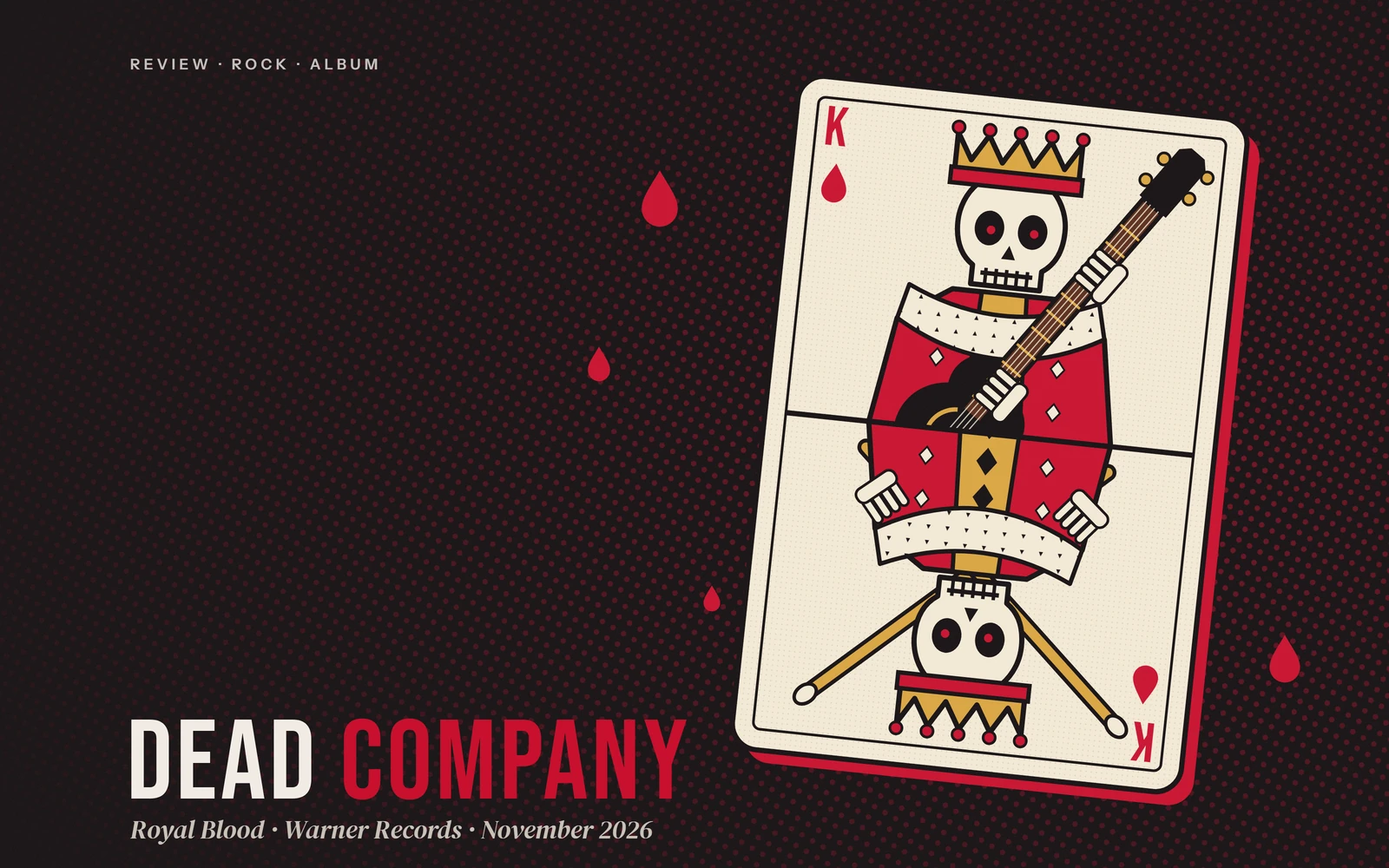
The illustration at the top of this review is our own original image, not the album's sleeve or the band's logo. We drew it as a hand-pulled gig poster of a playing card: the King of Blood. A court card is two mirrored halves that only work together, and so is Royal Blood. In the top half, a crowned skeleton king holds a bass; in the bottom half, his upside-down twin holds the drumsticks. Dead company, royal blood, two players, one card.
Verdict
6.4/10rock.news review score · how we score
Verdict: Dead Company is Royal Blood at their tightest, fastest and most physical: ten songs, half an hour, no guitar and no wasted motion. "Swallow the Bomb", "Ten Over Ten" and "Rear View Mirror" will tear up festival fields next summer, and the playing is the best of their career. But after two albums of brave, uneven attempts to grow, this is a step back into the comfort zone, with lyrics that never land and almost nothing you have not heard them do before. A great live band's great live set, on record. A good album, not an important one.
No ranking score yet: the album came out after the window of our first-half rankings, so the score above is our review score alone.
Dead Company came out after the window of our first-half rankings, so it is not in our rankings yet. For the year's best-rated rock records so far, see Rock 2026.
Artists in this piece Royal Blood, AC/DC, Queens of the Stone Age, The White Stripes