The Body & Cel Genesis — Whole Wide World
Two drummers, a wall of distortion, a man screaming like a kettle and a trance pad the size of a cathedral. It is the strangest record of the week, and the most hopeful thing these people have ever made.
 By Huginn
There is a moment on almost every record The Body make when you realise you have stopped listening to music and started enduring weather. Whole Wide World has those moments too. But this time, somewhere under the hail, someone has left a rave running. Made over two years with the Oakland industrial hardcore project Cel Genesis, it is the most unusual heavy record of the week, possibly of the month, and the first record by The Body that you could, with a little courage, dance to.
Two bands that never learned to sit still
The Body are Chip King and Lee Buford, a duo that started in Providence, Rhode Island, and has lived in Portland, Oregon, for years. On paper they are a doom band: Buford plays drums like he is trying to drive them into the floor, and King plays guitar and screams in a register so high and so ragged that first-time listeners often assume something is wrong with their speakers. In practice they are one of the restless collaborators in heavy music. For two decades they have made records with sludge bands, noise artists, choirs and electronic producers, and nearly every time they come out with something that sounds like neither party.
Cel Genesis are less famous and in some ways stranger. The Oakland project makes punishing industrial and hardcore techno, the fast, distorted, deliberately abrasive end of club music, and presents itself on stage as a sinister megacorporation of the same name. Cel Genesis bring their own drummer, Nick Cowman, which gives the record its secret weapon: two drummers, Buford and Cowman, playing against and underneath programmed beats.
The idea came up while the two acts were touring together. The rules, according to the label, were few: friendship, humility and a willingness to give up some control. Some songs started from Cel Genesis's electronic beds, which the group then cut up and rearranged; others started from live drum sessions that were edited and rebuilt. It was recorded with Seth Manchester at Machines with Magnets in Pawtucket, Rhode Island, with more sessions in California, and it took about two years.
What it sounds like
Imagine a late-nineties trance anthem, the kind with a long rising synth line and a drop that makes a field of strangers raise their arms at once. Now imagine it played through a broken amplifier in a flooded basement, while two drummers try to knock the building down and a man screams from the far end of a corridor. That is roughly Whole Wide World, and the strange part is how often it is beautiful.
The key is that nobody here is joking. The trance elements are not ironic samples or a wink at rave nostalgia; they are big, sincere, open-hearted melodies, and The Body treat them with the same seriousness they bring to a funeral march. The distortion does not mock the euphoria. It tests it. Again and again a melody rises, gets buried under noise and climbs back out, and the record becomes a long argument about whether joy can survive pressure.
It is also very physical music. The double drumming gives the album a pulse that programmed beats alone never could: when the live kit and the machine line up, it hits like a stampede; when they drift apart, the songs seem to stagger. King's vocals work the same way. They are less lyrics than a kind of weather report from inside the body, a texture of pain set against the music's optimism.
The songs
"Ghost" is a short opening statement, a little over three minutes, that shows you the rules: drones, noise, a voice in the distance, and the first sense that there is a melody somewhere underneath trying to get out.
"Candy Crush", the first single and the centre of the record, is the one to play to anybody who asks what this sounds like. It starts as almost pure horror, shrieking vocals over ominous drones, and then, after what feels like a very long time, a slamming rave beat kicks in and the whole thing turns from a haunted house into a warehouse party. At nearly six minutes it is one of the longest pieces here, and the title is the funniest thing on the record: a song named after a phone game about matching sweets, which sounds like the end of civilisation with a strobe light.
The track titles tell the story the music only hints at. "Negative Sum", "Memories", "To Be Eviscerated" and "Remind Me" circle the same themes: nostalgia, lost hope, and the sense that the future everyone was promised in the nineties, the one the rave generation danced towards, never arrived. The label calls the band "unrelenting optimists" processing the death of possibility, and that is the best description of the album's mood: grief that refuses to stop dancing.
The closer, "Everything", is the shortest statement after "Ghost", about three minutes, and it ends the record the way it started: in the dark, but not quite alone.
Why it matters
Heavy music and electronic music have been flirting for forty years, and most of the time one side wins. Industrial metal turned the machines into a backing band. Most "metal meets techno" records use the drums of one genre and the guitars of the other and call it a fusion. Whole Wide World is different because neither party seems to have won. It is not a metal record with beats or a techno record with screaming. It is a third thing, and you can hear the friction of four musicians giving ground to one another in every song.
That friction is also where the record's emotional power comes from. The Body have always made music about suffering; here, for the first time, they have made music about suffering and hope at the same time, and the hope is not decoration. In a year of very good heavy records that do exactly what you expect them to, this one does something nobody asked for and almost nobody else could do.
The reservations
It is hard work. If you do not already enjoy at least one of the two worlds it comes from, the first listen can feel like being shouted at in a nightclub with the lights off, and the vocals in particular will divide people. King's scream is an acquired taste even on The Body's own records, and here it is often mixed as one more layer of noise, so if you want words to hold on to, there are very few.
The middle of the album also blurs. Without the shock of "Candy Crush" or the frame of the opener and closer, a couple of tracks in the second half rely on the same rise-bury-rise shape, and on headphones at volume the density can become simply tiring rather than overwhelming. A slightly shorter, more ruthless edit would have made a great record out of a very good one.
The cover
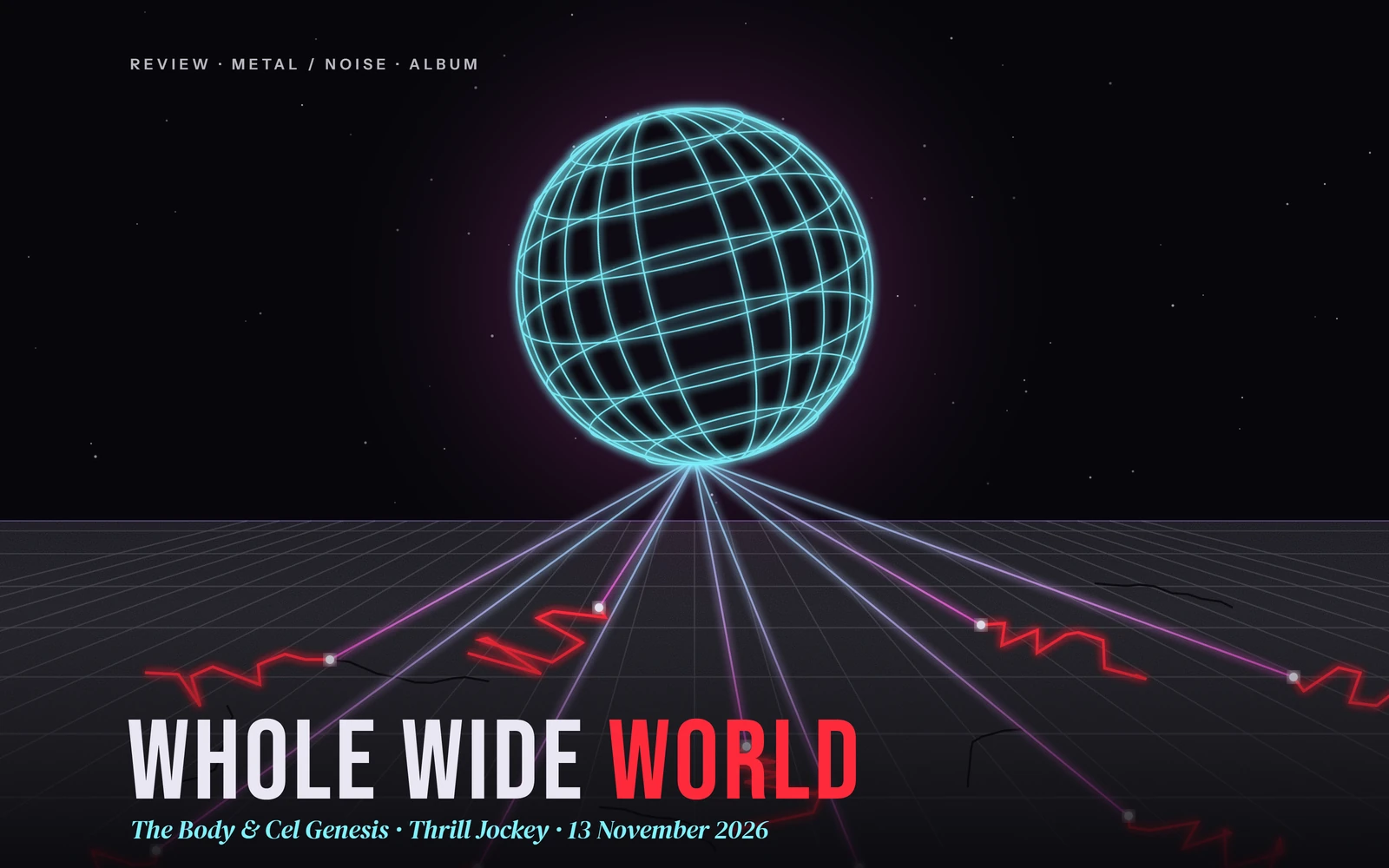
The illustration at the top of this review is our own original image, not the album's sleeve. It is built from the record's idea rather than its artwork: a whole wide world reduced to a glowing wireframe globe hanging over an empty dancefloor, its laser lines fanning out like a rave light show and breaking into red distortion where they hit the ground.
Verdict
7.8/10rock.news review score · how we score
Verdict: Whole Wide World is a rave record for the end of the world, and a far warmer one than its ingredients suggest. The Body's doom and screaming, Cel Genesis's hardcore techno, two drummers and a pile of sincere trance melodies collide into something that sounds like nobody else this year. It is too dense in the middle and too punishing to win over everyone, but it is brave, physical, strangely hopeful and genuinely new. Start with "Candy Crush", play it loud, and wait for the beat.
No ranking score yet: the album came out after the window of our first-half rankings, so the score above is our review score alone.
Whole Wide World came out after the window of our first-half rankings, so it is not in our rankings yet. For the year's best-rated metal records so far, see Metal 2026.
Artists in this piece The Body, Cel Genesis