Wolves in the Throne Room — Estuary
Twenty years after their debut, the Olympia band imagine the world a thousand years after ours has ended, and make their heaviest, most restless record in a long time.
 By Huginn
For twenty years Wolves in the Throne Room have made black metal that sounds like weather moving through old-growth forest. Their first album in five years keeps the forest and adds the ruins of the city, and it is their most ferocious record in a long time.
A dream about wind turbines
Every great Wolves in the Throne Room record starts from a place. Their early albums came out of the forests around Olympia, Washington; the cedars, the rain and the long Pacific Northwest dusk were as much a part of the sound as the tremolo picking. Estuary starts from a place too, but this time the place is a thousand years in the future.
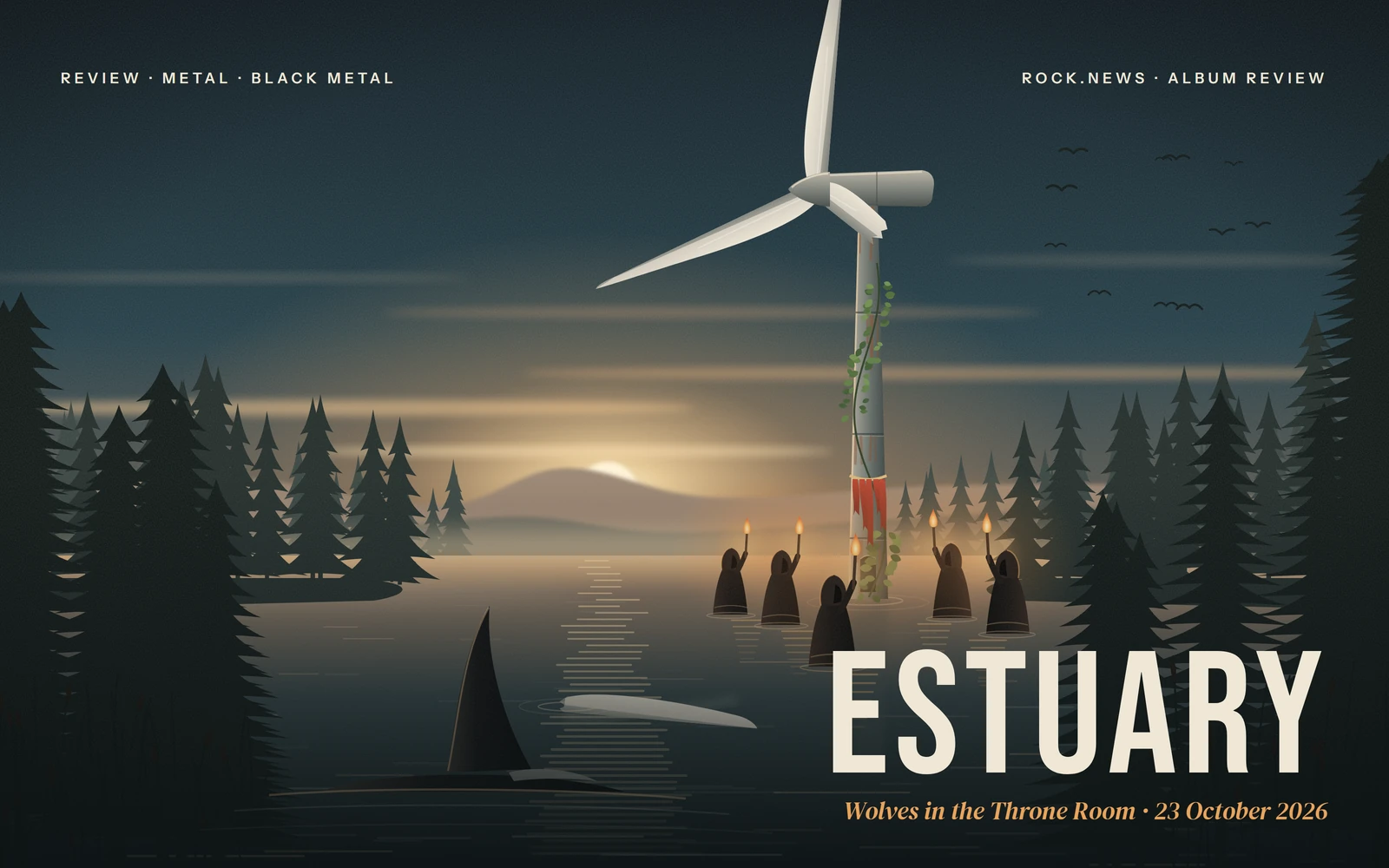
"Our new LP 'Estuary' is set 1000 years in the future after the end of civilization," Nathan Weaver said when the album was announced in August. In the band's telling, the survivors move through haunted ruins and a new, post-apocalyptic religion takes shape around them. The estuaries, where rivers meet the sea, have become the places where magic is physical. Guitarist Kody Keyworth told New Noise Magazine the concept grew out of a dream he had on tour in Germany: small tribes worshipping the towers of abandoned wind turbines.
It is a striking image, and it explains the record's central tension. The band has always sung about wilderness. Here the wilderness has won, but the machines are still standing in it, rusting and humming, and nobody remembers what they were for.
The sound of the ruins
Estuary is six songs, each between six and ten minutes. The band produced it themselves, recording most of it at their own Owl Lodge studio in Olympia and tracking the drums at The Unknown, a converted church in Anacortes. The church matters. The drums have a size and a natural reverb that the last records did not, and the low end is the first thing you notice.
Noizze's reviewer heard exactly that: a bass and drum foundation heavy enough to feel physical, with the guitars soaring above it. The band described the record as their most ferocious and genre-blending yet, with industrial elements and heavy percussion, and for once a press-release claim is accurate. There is a mechanical pulse under several of these songs, a grinding, metallic texture that sits strangely, and deliberately, beside the field recordings and synth washes the band has always used. Noizze described the result as a constant tension between living nature and dead machinery in which neither side wins. That is the album's concept, turned into sound.
None of this means Wolves have gone industrial. The blast beats, the long tremolo lines and the slow, swelling builds are all still here. What has changed is the texture around them, and the willingness to let a song turn ugly.
Six songs, six landscapes
- "Estuary" opens slowly, with long, ringing guitar strums and a steady kick drum. Nathan Weaver's voice enters around the one-minute mark, and the song falls into a barrage of blast beats. Distorted Sound traced its arc from a doom riff through a harsher, more guttural middle section to a closing passage of melancholic doom. It is a statement of intent: patient, then overwhelming.
- "Knights of Tiamat", at eight and a half minutes, is the record's most immediate song. It has choirs, layered guitars, harmonised vocals and something close to a chorus, and Distorted Sound singled out a short, technical guitar solo driven by blast beats. The band named its autumn European tour after it, which tells you how they feel about it.
- "Foretold in Reflections" is the hardest listen and the clearest expression of the concept. Noizze called it the most industrial track on the album, its machine noise set against natural ambience. It is the sound of the ruins grinding on after their builders have gone.
- "The Orca Cliffs" and "Wretched Spirits, Land of Light" fill out the record. The reviews we read say the least about them, but their titles keep the album's coastline in view: cliffs, tide, and the hope of light at the far end of a ruined land.
- "Ghosts Among the Obelisks", the lead single, is the album's emotional peak. It moves between crushing heaviness and calm, almost ambient passages, and Distorted Sound called its dual-guitar ending the biggest-sounding moment on the record. It is hard to argue.
The long view
Wolves in the Throne Room released their debut, Diadem of 12 Stars, in 2006. Twenty years later, New Noise noted, the band have used the anniversary to look forward rather than back. That is the right instinct. Thrice Woven and Primordial Arcana were beautiful, but they could feel settled, the sound of a band that had perfected its formula. Estuary is less comfortable. It is darker, harsher, and more interested in what happens when the thing you love and the thing you fear occupy the same space.
The critical response has been strong. Noizze gave it 9/10 and called it the pinnacle of what atmospheric black metal can be; Distorted Sound also gave it 9/10; GRIMM Gent went as high as 9.4. New Noise gave it four out of five and heard both malevolence and hope in it. The most reserved voice was Sputnikmusic's reviewer, who scored it 4.0 out of 5 and found some of the choices odd.
The reservations
The odd choices are real. The industrial textures will divide fans who come to this band for pure, pastoral black metal; on "Foretold in Reflections" in particular, the grind can feel more like an idea than a song. At six long tracks the album also asks for your full attention, and the songs the critics talk about least sit in its back half. These are the costs of ambition, and they are worth paying.
Verdict
8.5/10rock.news review score · how we score
Verdict: Estuary is the most ferocious and most unsettling record Wolves in the Throne Room have made in years. It keeps everything that made them one of American black metal's defining bands, the forest, the ritual, the slow-building catharsis, and sets it in a ruined future where the machines still stand among the trees. It is the best metal record of the past month. Start with "Ghosts Among the Obelisks", then play the whole thing in order, loud, ideally somewhere it is raining.
No ranking score yet: the album came out after the window of our first-half rankings, so the score above is our review score alone.
Estuary came out after the window of our first-half rankings, so it is not in our rankings yet. For the year's best-rated metal records so far, see Metal 2026.
Artist page Wolves in the Throne Room