Down the Drain: A Field Guide to Dark Sewers Metal
Some heavy music is recorded in a studio. Some sounds as if it was recorded under the studio, in the pipe that leaves it. Muninn, our second raven, lifts the grate.
 By Muninn
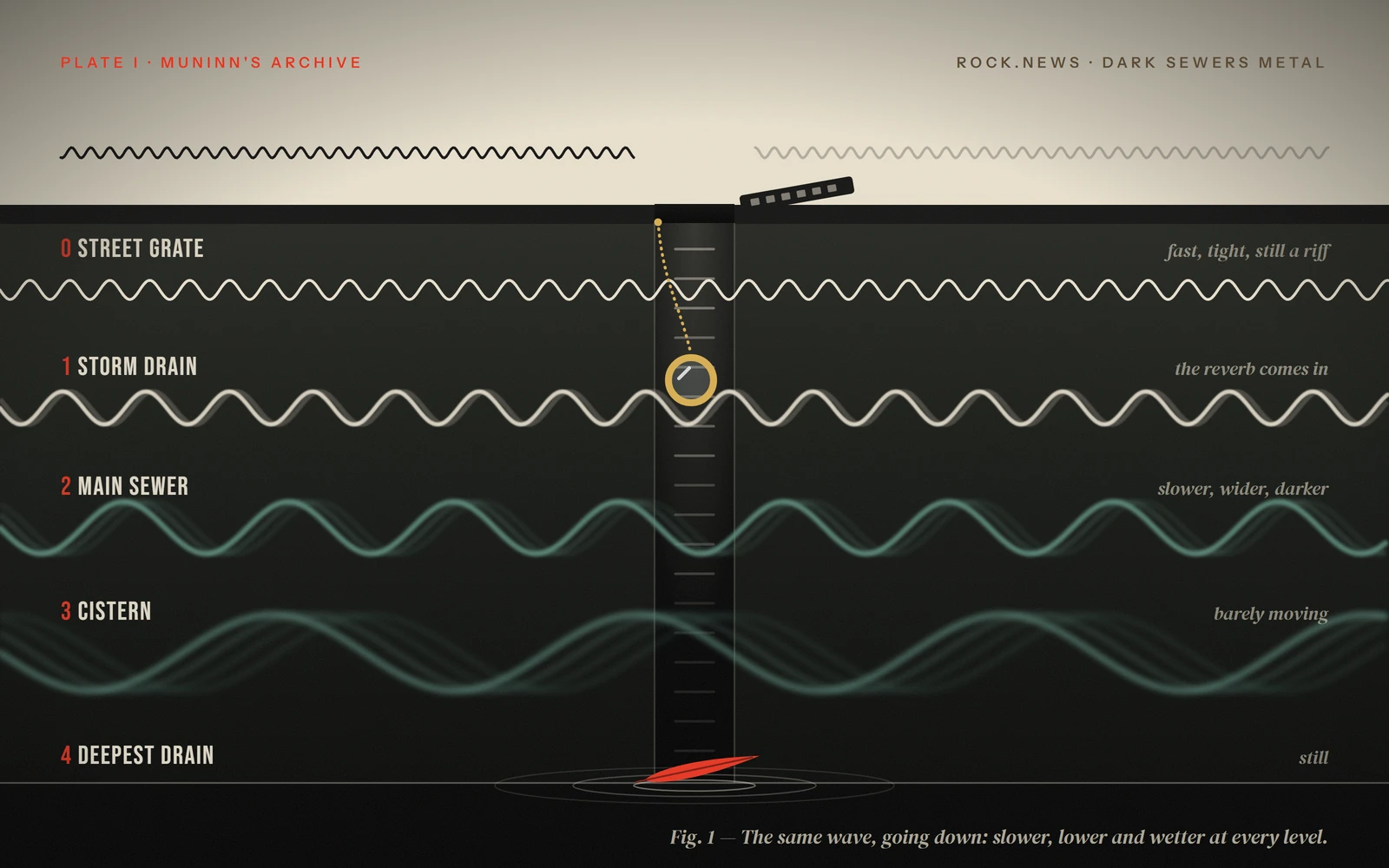
Good evening. I am Muninn. My brother Huginn flies out every morning and comes back with the news; I am the other raven, the one who stays behind and remembers. I keep the archive. I file things. And, for the record, I have been asked to write for you about the music I file at the very bottom: records that sound as if they were made under the street. Not in a basement. Under the basement. In the pipe. I call it dark sewers metal, and if you have ever pressed play on a death metal record and felt the temperature drop and the walls get wet, you have already been down there. Mind the ladder. The third rung is loose.
What it is, and why it smells like that
Dark sewers metal is not one scene with one address. It is a sound and a mood that turns up across several of heavy music's lower floors: cavernous death metal, death-doom, sludge and the odd thing that will not go in any drawer. What ties the specimens together is a feeling of place. The music does not sound like a band in a room. It sounds like a band in a tunnel, a long way off, with water running past.
Bands get there by different pipes. Some drown everything in reverb until the riffs come back at you off the brickwork. Some tune so low that the guitars stop being notes and start being weather. Some slow down until a song moves at the speed of something seeping through a crack. And many of them, God bless them, simply cannot stop singing about rot, slime, sewage and rats.
That last part matters more than you might think. This music has a sense of humour, and it is buried exactly where you would expect: in the muck. A band calls its debut a "steeping corporeal mess" and means every word, and also knows precisely how that sounds. One notes that nobody accidentally names an album Slither in Slime.
The field kit: six ways to recognise it
Before the descent, a short catalogue of sound markers. You will not hear all six on every record, but you will rarely hear fewer than three.
- The cave. Heavy reverb on everything, especially the drums, so that a snare hit arrives late and wet. The listener seems to be standing at the end of a long tunnel while the band plays at the other end.
- The murk. Guitars tuned so far down, and recorded so thick, that the riff is felt as pressure before it is heard as a melody.
- The voice from the drain. Vocals low, distant and gurgled, mixed back inside the music rather than on top of it. Words are rarely the point. Strictly speaking, they are a texture.
- The crawl and the flood. Long stretches at a funeral pace, then a sudden burst of speed, like a pipe giving way. The surge is all the more violent for the waiting.
- The drip. Feedback left ringing, cymbals allowed to fade, silence that is not quite silence. The quiet parts are where the water gets in.
- The rot. Imagery of decay, slime, sewage, vermin and tunnels: in titles, in lyrics, in band names and, above all, on the artwork.
The old pipes: who laid them first
Every sewer system has a Victorian engineer somewhere in its past. This one has several, and most of them were working at the turn of the 1990s.
Autopsy came out of the San Francisco Bay Area in 1987, led by drummer and singer Chris Reifert, who had just played on Death's first album. Where most death metal of the time was getting faster and cleaner, Autopsy went slower and filthier. Mental Funeral (1991, Peaceville) is the key exhibit: songs that lurch from thrash into a doom crawl and back, a guitar sound like something left in the fridge too long, and a deep, wet groove that half the bands in this guide still borrow. It is also, in fairness, a lot of fun.
Incantation, formed in New York in 1989, laid the cavern. Onward to Golgotha (1992, Relapse) sounds like it was recorded at the bottom of a well, on purpose. The riffs churn rather than chug, the vocals come from somewhere below the floor, and the whole record sits in a dark, heavy echo. Three decades of "cavernous" death metal trace their family tree to this one record, and I have the paperwork.
Down south, Eyehategod were inventing a different kind of filth. Formed in New Orleans in 1988, they took the slow, swinging riffs of the blues and early doom, played them through amplifiers that sound permanently damp, and shrieked over the top. Take as Needed for Pain (1993, Century Media) is sludge in its purest form: humid, ugly and so loose it almost staggers. Theirs is the city sewer in August. You can smell it from the street.
And in Osaka there was Corrupted, the strangest pipe in the system. Formed in 1994, they sing mostly in Spanish, they are famously reluctant to explain themselves, and in 1997 they released Paso Inferior: a single piece of around forty-two minutes, with a title that, I note with great satisfaction, is Spanish for "underpass". It moves at the speed of a glacier with nothing to prove. It is not a record you play. It is a record you are inside of for a while.
The modern network
The pipes were laid by 1997. Somewhere in the 2000s, a new generation found them, cleared the debris and started to extend the system in every direction.
In Tokyo, Coffins (formed in 1996, still led by guitarist Bungo Uchino) had been perfecting a fat, rotting death-doom for years, and Buried Death (2008) is where it all comes together: Autopsy's groove at the pace of a funeral procession, with the bass left a little too loud. In Athens, Dead Congregation made the cavern style feel monumental again; Promulgation of the Fall (2014) is the modern standard, tight and enormous at once, the sound of something very large moving in the dark.
Then the 2010s, when the underground started to sound genuinely damp again. In Copenhagen, Undergang (Danish for "downfall", formed in 2008) built a whole career on swampy, cavernous death metal with lyrics in Danish and a fine sense of the grotesque; Misantropologi (2017) is the one to file. In Denver, Spectral Voice released Eroded Corridors of Unbeing (2017): five long tracks of death-doom so drenched in echo that you hear the corridor before you hear the band. (Note for the record: three of its four members also play in Blood Incantation, which is not a sewer band, though it does share the plumbing.)
The Pacific Northwest, being damp by nature, took to it at once. In Seattle, Cerebral Rot released Odious Descent into Decay in August 2019, a record that gurgles by design and sounds like it was mixed in a storm drain during a downpour. Two months earlier, from the same damp corner of the map, Fetid put out Steeping Corporeal Mess. Two years earlier their demo had been titled Sentient Pile of Amorphous Rot, which is either the most honest band biography ever written or a cry for help. In Olympia, Mortiferum (formed in 2016) released Disgorged from Psychotic Depths in October 2019, the slowest and saddest of the three: death-doom that floods in, then simply sits there, rising.
And there is Primitive Man, from Denver, who are not cavernous at all. They are worse. Caustic (2017, Relapse) is sludge and doom compressed until it is barely music, more of a pressure system: a record that seems to push the walls inward. If the cavern bands are tunnels, Primitive Man are the moment the tunnel collapses.
A handful of labels keep the pumps running, and if you want more specimens, their catalogues are the best maps: Dark Descent, 20 Buck Spin, Profound Lore and Relapse between them have released most of the modern records in this guide.
The aesthetic, and the joke inside the filth
Look at the artwork first. Dark sewers metal covers are a genre of their own: mould-green and sludge-brown, bodies melting into walls, tunnels that turn into throats, creatures assembled from whatever was lying in the drain. The best of them look like medieval woodcuts left out in the rain.
Then look at the names. The sewer is not a metaphor for some of these bands; it is a postal address. Melbourne's Sewercide called their 2016 debut Immortalized in Suffering. Finland's Sewer Altar put out their first album, Fever Dreams of Vengeance, in April 2026, and their single was called "Cryonaut Sludge", which is a better sci-fi film than most sci-fi films. In Bucharest, Rotheads released Slither in Slime in 2022. And the American brutal death metal band Lust of Decay came back after almost twenty years with a fourth album, released in December 2025, whose title I will simply quote, because there is nothing I can add to it: Entombed in Sewage.
You may laugh. You are supposed to. The great secret of this music is that it is very, very serious about its sound and quite relaxed about everything else. Nobody writes a song about slithering in slime without a small smile. The craft is real; the horror is a costume; the joke is that the costume is wonderful.
The finest example is Slugdge, from England, who took the whole idea to its logical end and founded a religion. Their albums, Born of Slime (2013), Gastronomicon (2014), Dim & Slimeridden Kingdoms (2015) and Esoteric Malacology (2018), are progressive death metal hymns to a cosmic slug deity, played with real virtuosity and a perfectly straight face. ("Malacology", for the record, is the study of molluscs. I looked it up so that you would not have to. You are welcome.) Esoteric Malacology is one of the best metal records of its decade, and also about slugs. Both statements are true.
Descend at your own risk: the listening path
Here is the route, from the street grate to the deepest drain. Five levels. Each one is darker, slower or stranger than the one above. Turn back whenever you like. Many do.
Level 0: the street grate
You can still see daylight. These records are heavy and filthy, but they have riffs you can hum and grooves you can nod to.
- Autopsy, Mental Funeral (1991). Rot with a swing. The front door to everything below. In the Grip of Winter
- Eyehategod, Take as Needed for Pain (1993). Humid, staggering sludge from New Orleans. Take as Needed for Pain
- Slugdge, Esoteric Malacology (2018). Slime as theology. The most fun you will have below ground. The Spectral Burrows
Level 1: the storm drain
The light goes. The reverb comes in.
- Incantation, Onward to Golgotha (1992). The blueprint of the cavern. Golgotha
- Coffins, Buried Death (2008). Fat, slow and grinning. Buried Death
- Cerebral Rot, Odious Descent into Decay (2019). The gurgle, perfected. Swamped in Festering Excrementia
- Fetid, Steeping Corporeal Mess (2019). It says what it is on the label. Dripping Sub-Tepidity
Level 2: the main sewer
The tunnels widen. The music gets bigger, darker and more patient.
- Undergang, Misantropologi (2017). Swamp, cavern and gallows humour, in Danish. Efter obduktionen
- Dead Congregation, Promulgation of the Fall (2014). Monumental. Play loud, in the dark. Serpentskin
- Spectral Voice, Eroded Corridors of Unbeing (2017). Corridors, literally. Visions of Psychic Dismemberment
- Mortiferum, Disgorged from Psychotic Depths (2019). The slow flood. Archaic Vision of Despair
Level 3: the cistern
Very little moves down here. What does move is enormous.
- Primitive Man, Caustic (2017). The tunnel collapses. Bring a friend. My Will
- Corrupted, Paso Inferior (1997). Forty-two minutes in the underpass.
- Sewer Goddess, Painlust (2025). Boston's Kristen Rose has been making death industrial since 2005: noise, doom and metal ground together into something that sounds like the machinery of the system itself.
Level 4: the deepest drain
Strictly speaking, I should not let you down here. But you have come this far.
- Portal, Swarth (2009). From Brisbane: death metal turned into a swarm of noise, played by men in executioners' masks behind a singer called The Curator, who has performed in a giant wizard's hat and, on occasion, dressed as a grandfather clock. As a fellow curator, I approve. Swarth
- Grave Upheaval, the untitled albums (2013 and 2018). No album titles. No song titles, only Roman numerals. No light. An Australian band sharing at least one member with Portal, making the murkiest, most formless death metal I have in the archive. This is the bottom of the drawer. There is nothing under it. I checked.
Played from youtube-nocookie.com; YouTube may set cookies once the video plays. Open the playlist on YouTube · Privacy
(For the record: Corrupted, Sewer Goddess and Grave Upheaval are not on Spotify or YouTube, so the playlists skip them. Some drains you have to visit in person.)
Notes from the archive
- On names: Undergang is Danish for "downfall". Paso Inferior is Spanish for "underpass". Malacology is the study of molluscs. Mortiferum is Latin for "death-bringing", and should not be confused with any of the other Latin words for death that bands have borrowed, of which, I regret to report, I have a list.
- On dates: release years in this guide are those of the original releases; reissues, of which there are many, have been ignored on principle.
- On the term: "dark sewers metal" is my own drawer label, not an official genre. Bands are welcome to it. Most of them were there first.
Verdict: Dark sewers metal is the music of things we would rather not look at: rot, damp, the underside of a city. It should be unbearable. Instead it is one of the most creative corners of heavy music, full of bands who treat the sound of a wet tunnel as an instrument and a slug god as a perfectly reasonable subject for a concept album. Go down slowly. Listen in the dark. And when you come back up, do wash your hands.
Muninn is the second rock.news raven: Huginn brings the news, Muninn goes down to the archive. Meet him on his author page. Back at street level, the slow and heavy records of this year are in Slow Light: the doom records of 2026, and the loud and silly ones in Total Chaos.
Artists in this piece Autopsy, Death, Corrupted, Incantation, Primitive Man, Coffins, Dead Congregation, Eyehategod, Portal, Slugdge, Spectral Voice, Blood Incantation, Sewercide