Slow Burn
Some songs explode on release day. These ones smouldered for years in bargain bins, B-sides and closing tracks, until a film, a phone, a Christmas campaign or a stubborn cult set them alight. Twenty-one sleeper hits from rock, punk and metal, and how they woke up.
 By Huginn
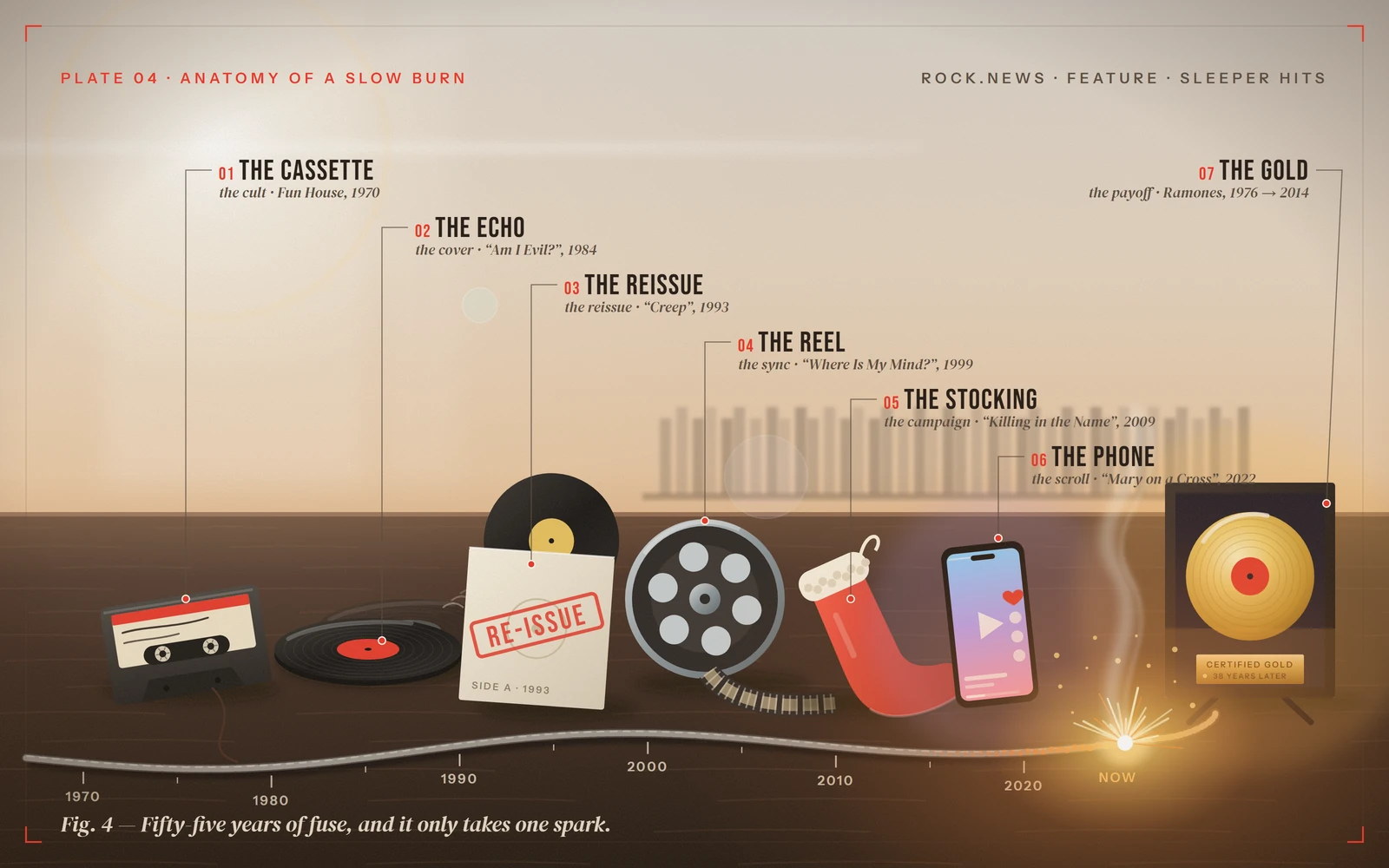
The music business loves a first week. Debut positions, opening sales, first-day streams: a record is supposed to arrive, peak and fade, all within a couple of months. Most records do exactly that. But every so often a song refuses to die quietly. It sells a few thousand copies, misses the chart or limps in somewhere near the bottom, and the label moves on. Then, a year or a decade or four decades later, something lights the fuse: a film director, a teenager with a phone, a Christmas protest, a band that covers it, or simply a cult that grew big enough to count. This is a feature about those songs. We picked 21 of them from rock, punk and metal, checked every chart position and certification against the archives, and tried to work out what woke each one up.
What counts as a sleeper hit
A sleeper hit is a song or album that did little or nothing on release and became a hit later. That rules out the comeback: a song that was already big, faded, and came back. Kate Bush's "Running Up That Hill" was a top-three single in Britain in 1985 before the Stranger Things generation found it, and Fleetwood Mac's "Dreams" was an American No. 1 decades before a skateboarder and a bottle of cranberry juice made it viral. Wonderful stories, but those are revivals, not sleepers.
It also rules out the merely slow climber, though the line can be thin. Foster the People's "Pumped Up Kicks" began as a free download on the band's website in early 2010, travelled through music blogs, a fashion magazine's online ad campaign, satellite radio and a TV placement, and only reached No. 3 on the Billboard Hot 100 in the summer of 2011. That is a hit that took a year to happen, not a flop that was forgiven. Everything below started life as a failure, a footnote or a secret.
Six ways a song wakes up
Read enough of these stories and the same few triggers keep turning up.
- The sync. A film or a series puts an old song in exactly the right scene, and millions of people go looking for it the same night. This used to take months. In the streaming age it takes hours.
- The scroll. A short clip on TikTok, often slowed down or cut to its best ten seconds, introduces a song to people who were not born when it came out. The song does not need a plot. It needs a mood.
- The reissue. A label puts a failed single out again because it caught on somewhere else, usually abroad, and the second time the home country is ready.
- The campaign. Fans decide, collectively and on purpose, to make a song a hit, usually to annoy someone.
- The cover. A bigger band records the song, and the royalties, the curiosity and eventually the respect flow back to the people who wrote it.
- The cult. Nobody lights the fuse at all. A record just keeps being passed from hand to hand, sold a few hundred copies a month, for years, until the numbers finally add up to gold.
And sometimes, sadly, there is a seventh: an artist dies, and the world finally listens to what it had been ignoring.
Rock
Radiohead — "Creep"
Parlophone · September 1992 · from Pablo Honey · fuse: one year
The most famous sleeper in British rock was released on 21 September 1992 and went almost nowhere. It reached No. 78 on the UK singles chart and sold about 6,000 copies. National radio in Britain kept it off the playlist for being too depressing, which, in fairness, is one way of describing a song whose chorus is "I'm a creep."
Then it escaped. Radio abroad picked it up, first in Israel, where a DJ championed it in late 1992, and then on American alternative and college stations. By the middle of 1993 "Creep" was an American hit, on its way to No. 34 on the Hot 100. The pressure to try again at home became overwhelming: from radio, the press, the label and, as bassist Colin Greenwood later put it, even the fans. The band, who already resented the song, gave in. The reissue came out in September 1993, the band played it on Top of the Pops, and this time it went to No. 7. The rest of their career has been, in part, a long and brilliant argument with that one song.
The Cranberries — "Linger"
Island · February 1993 · from Everybody Else Is Doing It, So Why Can't We? · fuse: one year
Same story, same years, different island. The Cranberries' "Linger" first came out in the UK in February 1993 and stalled at No. 74. American alternative radio, however, fell for Dolores O'Riordan's voice and that swaying string arrangement, and the song worked its way up the US charts through 1993. By February 1994 it had reached No. 8 on the Billboard Hot 100. Island reissued it at home at the end of January 1994, and Britain, a year late, put it at No. 14. It was the start of a run that made the Cranberries one of the biggest bands of the decade. Nobody who heard the first release would have guessed.
The Killers — "Mr. Brightside"
Lizard King · September 2003 · from Hot Fuss · fuse: one year, then forever
The first release of "Mr. Brightside" was barely a release at all: a small British run on 7-inch and CD in September 2003, on an independent label, by a band from Las Vegas nobody in Britain had heard of. It came and went. When it was reissued in May 2004, it reached No. 10, which counts as a solid hit and nothing more. It also reached No. 10 on the Billboard Hot 100 in 2005.
What happened next has no real precedent. "Mr. Brightside" simply never left. Year after year it kept selling and later streaming enough to stay in the UK Top 100, through every wedding, every last orders and every student night in the country. By 2021 it had spent 260 weeks there; by 2026 its count was over 500. The Official Charts Company calls it the biggest single in British history never to reach No. 1. It is the purest slow burn in this list: a song that was a modest hit in 2004 and has been a hit every week since.
Pixies — "Where Is My Mind?"
4AD · March 1988 · from Surfer Rosa · fuse: eleven years, then twenty-six
"Where Is My Mind?" was never a single. The only single from Surfer Rosa was "Gigantic," and the album itself was a critics' record, not a chart one. The song might have stayed a fan favourite forever if not for the last scene of Fight Club in 1999: two characters holding hands at a window as the buildings across the city collapse, and Black Francis's wail of a chorus rising over the rubble.
That one scene turned an album track into the default soundtrack for every film, advert and trailer that wanted to say "something is ending, beautifully." Covers, piano versions and remixes followed by the hundred. In January 2025 the band announced that the original had passed one billion streams on Spotify, a song that never charted anywhere, now in the same club as the biggest pop hits on earth.
Weezer — Pinkerton
DGC · September 1996 · second album · fuse: twenty years
After a multi-platinum debut, Weezer's second album was supposed to be the victory lap. Instead Rivers Cuomo delivered a raw, uncomfortable, self-lacerating record about loneliness, longing and his own worst instincts. It debuted at No. 19 on the Billboard 200, sold well below expectations and was widely treated as an embarrassment, including by Cuomo himself, who spent years disowning it.
Then the record found its real audience: teenagers who heard their own awkwardness in it, and who grew up to form the emo bands of the 2000s. Pinkerton turned from flop to touchstone to classic, and in September 2016 the RIAA certified it platinum, eight days before its 20th birthday. The album that nearly broke the band has since been played in full on tour.
Mother Mother — "Hayloft"
Last Gang · September 2008 · from O My Heart · fuse: twelve years
Mother Mother were a respected Canadian indie band with a loyal following and a track on their second album called "Hayloft," a frantic, theatrical story of teenage lovers, a shotgun and a furious father. In 2008 it was an album track, nothing more.
In 2020 TikTok found it. In the first week of August that year, "Hayloft" was getting about 100,000 streams across all platforms; by October it was getting about a million a week, mostly from listeners who had never heard of the band. It became their most-streamed song by far, was certified platinum in the United States and gold in the UK, and the band did something no one expects a band to do with a 12-year-old album track: they wrote a sequel. "Hayloft II" came out in January 2022 and went gold in America on its own.
Arctic Monkeys — "505"
Domino · April 2007 · from Favourite Worst Nightmare · fuse: fifteen years
The closing track of Arctic Monkeys' second album was never released as a single. It was a slow-building love song that ends in a burst of noise, and for years it was the song fans waited for at the end of a show.
In 2022 it went viral on TikTok, and it has not come down since. It reached No. 2 on Billboard's Bubbling Under Hot 100 and No. 94 on the Billboard Global 200, which undersells what happened: by February 2026 "505" had about 2.6 billion Spotify streams, the band's third-biggest song. For a generation of listeners, the band that defined indie rock in 2006 is the band that made "505."
Punk
Ramones — Ramones
Sire · April 1976 · debut album · fuse: thirty-eight years
It is hard to think of a more influential debut album in punk, and hard to think of one that sold so badly. Ramones peaked at No. 111 on the Billboard 200. Fourteen songs, under half an hour, about glue, Nazis, chainsaws and wanting to be your boyfriend: American radio did not know what to do with it, and mostly did nothing.
The album sold steadily for decades, to every new kid who picked up a guitar and discovered three chords would do. On 30 April 2014, 38 years after it came out, the RIAA finally certified it gold for 500,000 copies. By then Joey, Dee Dee and Johnny were gone. Tommy Ramone, the last surviving member of the original line-up, lived to see it by about ten weeks. It is the slowest gold record in this feature, and possibly the most deserved.
The Stooges — Fun House
Elektra · July 1970 · second album · fuse: fifteen years and counting
Fun House did not chart. It drew a nearly unanimous drubbing from critics, sold poorly, got almost no radio play and was treated by its own label as a commercial letdown. Recorded more or less live in the studio, with the band playing as if the room was on fire and a saxophone screaming over the final track, it sounded to 1970 like noise.
It took the generation it created to rescue it. Through the 1980s, punk and hardcore musicians kept naming it as the source; Henry Rollins was one of its loudest champions in print in the mid-1980s, and the album was quietly put back in print, with its first CD reissue in 1988. In 1999 a limited box set released every take from the sessions. It is a sleeper of the purest cult kind: it has never had a big chart moment, and it never needed one. Ask a punk guitarist what the most important record in the genre is, and an alarming number will name an album that most of 1970 ignored.
Iggy Pop — "Lust for Life"
RCA · 1977 · from Lust for Life · fuse: nineteen years
Iggy Pop and David Bowie wrote "Lust for Life" in Berlin, with a drum beat that sounds like a man running for his life, and in 1977 it was not a hit. The album did respectably; the song, now one of the best-known in rock, did nothing on the singles chart.
In 1996 Danny Boyle opened Trainspotting with it: Ewan McGregor sprinting down an Edinburgh street, the drums thundering, the "choose life" speech on top. The song was everywhere in the film's marketing, and on the soundtrack, and Virgin reissued it as a single on 11 November 1996. It reached No. 26 in Britain, nineteen years late, and has been the default soundtrack for anything involving running, escaping or nightlife ever since.
Death — ...For the Whole World to See
Recorded February 1975 · released by Drag City in 2009 · fuse: thirty-four years
Here is a sleeper that was asleep in a literal attic. Death were three brothers from Detroit, David, Bobby and Dannis Hackney, who started out playing funk and switched to a loud, fast rock sound after seeing the Who and Alice Cooper. In the mid-1970s, before the Ramones' first album came out, they were recording songs that sound exactly like punk rock. In February 1975 they recorded seven songs at United Sound in Detroit, paid for by Columbia Records boss Clive Davis, who asked them to change their name to something more commercial. They refused, and the support went away. A single, "Politicians in My Eyes," came out on their own label in 1976 in a run of 500 copies and vanished.
The master tape sat in an attic for more than thirty years. In 2008 a couple of the songs began circulating online, and one of Bobby's sons, a musician himself, heard them and recognised his father's voice. Drag City tracked down the original tape and in 2009 released all seven songs as ...For the Whole World to See. A documentary, A Band Called Death, followed in 2012. David, who had insisted on the name and believed the world would come round, had died in 2000. The world came round anyway.
The Cramps — "Goo Goo Muck"
I.R.S. · March 1981 · from Psychedelic Jungle · fuse: forty-one years
The Cramps took an obscure 1962 rockabilly song by Ronnie Cook and the Gaylads and made it into one of their trademark horror-movie stomps on their second album. It was a favourite of their fans, which in 1981 meant a small but very dedicated population of people with quiffs.
On 23 November 2022 Netflix released Wednesday, and in its fourth episode Jenna Ortega's Wednesday Addams dances, stiff-armed and unblinking, to "Goo Goo Muck." Before the premiere the song was getting about 2,500 on-demand streams a day in the United States. Five days later it was getting 134,000, and by 1 December more than 209,000, according to Luminate data. It went to No. 1 on Billboard's Alternative Digital Song Sales chart, the first time the Cramps had topped any Billboard chart. Singer Lux Interior had died in 2009. Guitarist Poison Ivy, his partner in the band and in life, saw a new generation of teenagers dancing to the two of them.
The Clash — "Should I Stay or Should I Go"
CBS · 1982 · from Combat Rock · fuse: nine years
This one was not a flop exactly: in 1982 it reached No. 17 in the UK. But for the most famous punk band in Britain, that was a mid-table result, and "Should I Stay or Should I Go" was regarded at the time as a lightweight, almost throwaway single from an album best remembered in America for "Rock the Casbah."
By 1991 the Clash had been broken up for five years. Then Levi's put the song in a television advert for its 501 jeans, the label reissued it in February 1991, and it went to No. 1. It was the only No. 1 single the Clash ever had, achieved after they had stopped existing and thanks to a denim commercial, which is either the funniest or the saddest punk story ever told. Twenty-five years later Stranger Things used it in its first season, and a third generation learned the chorus.
Dropkick Murphys — "I'm Shipping Up to Boston"
Hellcat · 2005 · from The Warrior's Code · fuse: one year, and never a Hot 100 hit
The words come from Woody Guthrie: a fragment of lyrics the folk singer left behind, which his daughter's archive passed to the Boston Celtic punk band. The first recording appeared on a compilation in 2004, and a re-recording, all mandolin, bagpipes and gang vocals, landed on The Warrior's Code in 2005. It was a strong album track for a band with a big local following.
Then Martin Scorsese used it in The Departed in 2006, the film went on to win best picture, and the song became the sound of Boston on screen and in every sports arena in America. In 2007 it reached No. 1 on Billboard's Bubbling Under Hot 100, the chart for songs just below the main one, and never climbed any higher. It did not need to. It has been certified platinum in the United States and gold in the UK, making it one of the rare million-selling American singles that never spent a single week on the Hot 100.
Metal
Diamond Head — Lightning to the Nations
Happy Face · 1980 · debut album · fuse: four years, then a pension
Diamond Head were one of the great hopes of the new wave of British heavy metal, and their debut album was pressed in a run of just 1,000 copies, in a plain white sleeve with no track listing, on the band's own label. The band never became the stars they were tipped to be.
But one teenager in California had the record. Lars Ulrich was a devoted fan, and when Metallica started, Diamond Head songs were in the set. In 1984 Metallica released their version of "Am I Evil?" as the B-side of "Creeping Death," and in 1998 their covers album Garage Inc. included four Diamond Head songs. Guitarist Brian Tatler has said many times that the royalties from those covers became the most important income of his life and let him keep making music. That is the sleeper hit in its strangest form: a song that became a hit, just not for the band that wrote it, and paid them anyway.
Ozzy Osbourne — "Crazy Train"
Jet · 1980 · from Blizzard of Ozz · fuse: forty-five years
It is one of the most recognisable riffs in rock: Randy Rhoads's opening run, played in every guitar shop and every stadium in the world. When "Crazy Train" came out as a single in America, it reached only No. 6 on the Bubbling Under chart. It never made the Hot 100.
It did not matter for decades. The song kept selling and later streaming, and in 2020 the RIAA certified it four times platinum. But its first Hot 100 entry came in the saddest way. Ozzy Osbourne died on 22 July 2025, and in the week that followed, after more than nine million US streams, "Crazy Train" entered the Hot 100 for the first time, at No. 46, 45 years after it was released. The song was always a hit. The chart just took until the end to say so.
Metallica — "Master of Puppets"
Elektra · 1986 · from Master of Puppets · fuse: thirty-six years
The title track was the only single from Metallica's third album, more than eight minutes of thrash released in July 1986. It did not chart. It did not need to: the album went multi-platinum without help from radio, and the song became the centrepiece of every Metallica concert.
On 1 July 2022, the fourth season of Stranger Things ended with Eddie Munson, the show's metalhead dungeon master, playing the "Master of Puppets" solo on top of a trailer in the Upside Down to distract a swarm of monsters. Within two weeks the song entered the Billboard Hot 100 for the first time, at No. 40, and went on to peak at No. 35. It also reached No. 22 in the UK, its first appearance there since 1986. A whole generation of teenagers learned a thrash riff because a fictional character played it to save his friends.
Rage Against the Machine — "Killing in the Name"
Epic · 1992 · from Rage Against the Machine · fuse: seventeen years
"Killing in the Name" reached No. 25 in Britain in early 1993, which is respectable for a song whose last line consists of one sentence repeated sixteen times and cannot be printed here. It became a rock-club staple and stayed there.
By 2009 the winner of The X Factor had taken the Christmas No. 1 in Britain four years running, and a couple of fans had had enough. They started a Facebook campaign to buy "Killing in the Name" instead in the Christmas week. It worked. On 20 December 2009 the song entered the chart at No. 1, with 502,000 downloads against 450,000 for the TV show's winner. It was the first Christmas No. 1 sold only as a download, and at the time the biggest one-week download sale in British chart history. The band thanked the country by playing a free concert in London the following summer. It is the only sleeper hit in this feature that was made a hit on purpose, out of spite. That feels right for the song.
Type O Negative — Bloody Kisses
Roadrunner · August 1993 · third album · fuse: two years for gold, seven for platinum
Type O Negative's Bloody Kisses was a 73-minute gothic doom record by four Brooklyn men with a sense of humour as dark as their guitars. It did not arrive as a hit. It spread slowly, through touring, word of mouth and a couple of songs that became late-night favourites, and on 9 November 1995 it became the first album in Roadrunner's history to be certified gold in the United States. In December 2000 it went platinum, another first for the label that would later sell millions of metal records.
The fuse is still burning. In June 2026, almost sixteen years after Peter Steele's death, "I Don't Wanna Be Me," a single from 2003, became the band's first song to go gold in America. Type O Negative were always a band you discover a little late; it turns out the whole world is discovering them late too.
Deftones — "Sextape"
Reprise · October 2010 · from Diamond Eyes · fuse: fifteen years
When "Sextape" came out as the third single from Diamond Eyes, the only chart that noticed it was a Mexican airplay chart, where it reached No. 32. It is one of the band's dreamiest songs, all slow-motion guitars and Chino Moreno's half-whisper, and its title made it a hard sell for radio.
A decade later a new generation found it, as so much of the Deftones catalogue has been found, through short videos and playlists that treat the band as mood music for being young and sad. The song turned up on TikTok's charts in Canada and the United States, and the streams kept building. In 2025 the RIAA certified it platinum and the BPI silver, fifteen years after its release, for a song that had once been a minor single.
Ghost — "Mary on a Cross"
Loma Vista · September 2019 · from Seven Inches of Satanic Panic · fuse: three years
Ghost released "Mary on a Cross" as one half of a joke: a two-song 7-inch single dressed up as a long-lost record from 1969, with a deliberately retro, harmony-drenched sound. It was a fan curiosity, the kind of side project a band puts out between albums.
In 2022 a slowed-down version on TikTok, set to edited clips from Stranger Things, set off a viral wave across the platform. In September 2022 the song entered the Billboard Hot 100 at No. 90, Ghost's first appearance on the chart. In November 2022 it went gold, in September 2023 platinum, and in November 2025 double platinum, the first song by the band to get there. The joke single became the biggest song Ghost have ever made.
What the slow burners have in common
Look at the list as a whole and a few things stand out. The fuse is getting shorter: in the 1970s and 1980s it took decades of steady sales for a cult record to add up to gold; today a sync or a viral clip can turn an old album track into a hit inside a week. The trigger is almost never the band. Labels, radio and the artists themselves mostly gave up on these songs, and it was a film editor, a teenager, a group of fans or another band who saw what was there. And the songs that wake up are rarely the ones that were designed as singles. They are the closing tracks, the B-sides, the oddities, the songs that were too long, too depressing, too strange or too rude for their own time.
Which means there is a lesson for anyone with a record collection: the song nobody noticed is not necessarily the song nobody will notice. Somewhere right now, on an album that came out to silence, there is a closing track waiting for its scene.
Listen · Spotify playlistrock.news: Slow BurnAll 21 sleeper hits in this feature, plus the slow climber from the intro. Light the fuse.PlayWant the songs that were big from day one? Read Anatomy of a Hit: what made rock, metal and punk songs big for 70 years, then see who is burning right now in Anatomy of 2025.
Artists in this piece Metallica, Death, Diamond Head, Ghost, Ramones, The Clash, The Cramps, The Cranberries, Type O Negative, Arctic Monkeys, Deftones, Iggy Pop, Mother Mother, Ozzy Osbourne, Rage Against the Machine, Weezer, Alice Cooper, Black Francis, Chino Moreno, David Bowie, Dolores O'Riordan, Dropkick Murphys, Fleetwood Mac, Foster the People, Henry Rollins, Kate Bush, The Killers, Lux Interior, Pixies, Poison Ivy, Radiohead, Rivers Cuomo, The Stooges, The Who