The Nicest Villain in Rock
Phoenix misfits, Zappa's weirdos, Detroit's loudest theatre troupe, a solo nightmare, three blackout records, one huge comeback and a 78-year-old who still gets beheaded on schedule. Our second Editor's Whim takes a seat in the front row with Alice Cooper.
 By Huginn
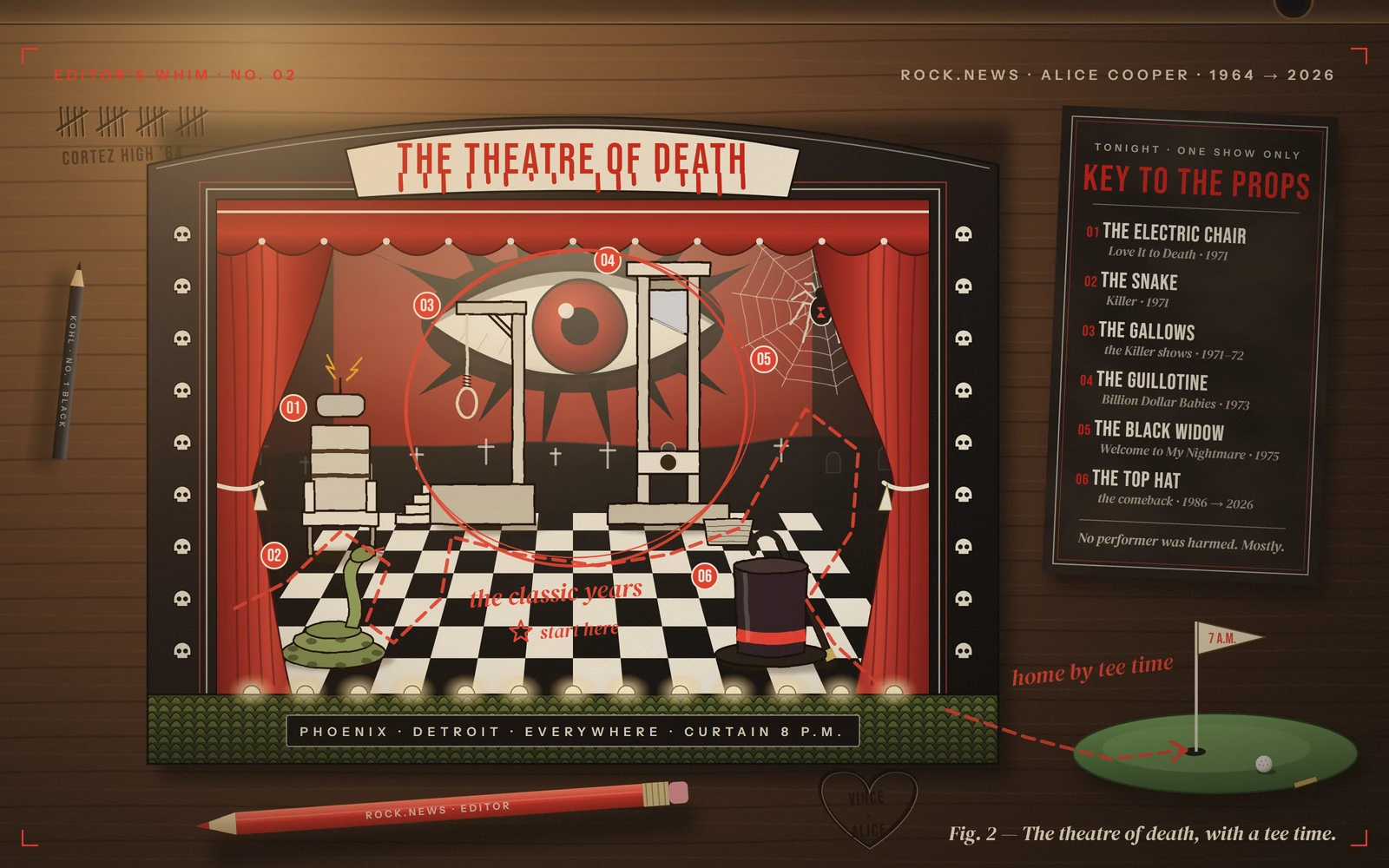
Every night for more than half a century, a man in black eyeliner has been put to death in front of a paying audience. He has been electrocuted, hanged and beheaded, sometimes in the same week. Then he has gone back to his hotel, slept well, got up early and played golf. Somewhere in between he quit drinking, found God, hosted a radio show for twenty years and wrote a memoir that went to No. 1 in Britain this October. He is 78, and he is still on tour. He invented the rock villain, and then he spent fifty years playing him as the nicest man in the business. Our second Editor's Whim is Alice Cooper. Please take your seats, and keep your hands away from the blade.
A preacher's son in the desert
The villain was born in Detroit on 4 February 1948 as Vincent Damon Furnier, named after an uncle and after Damon Runyon, the writer of gamblers and gangsters, which already feels like foreshadowing. His father was an evangelist in a small Christian church, and the boy who would one day bite the heads off nothing at all (we will get to the chicken) grew up in a religious home. He was a sickly child, and the family moved to Phoenix, Arizona, for the dry air.
In 1964, at Cortez High School, the 16-year-old Furnier and a group of friends from the cross-country team entered a school talent show. They called themselves the Earwigs and played parodies of the Beatles, in wigs. They won. Everything that follows grew out of that afternoon: boys who found out that dressing up, making people laugh and making a racket at once was the best feeling in the world.
The Earwigs became the Spiders, who had a local No. 1 in Phoenix in 1966 with "Don't Blow Your Mind." Then they became Nazz and drove to Los Angeles. The line-up settled into the five men who would make the classic records: Furnier on vocals, Glen Buxton on lead guitar, Michael Bruce on rhythm guitar and keyboards, Dennis Dunaway on bass and Neal Smith on drums. In 1968 they found out that Todd Rundgren already had a band called Nazz, so they needed a new name.
They chose Alice Cooper. The point was the contrast: a name that sounded like a nice girl from down the street, sweet and harmless, attached to five long-haired young men who looked like they had been dug up. Over the years a much better story attached itself to the choice, involving a Ouija board and the spirit of a 17th-century witch. The band were happy to let people believe it. Treat it as part of the show.
The name started out belonging to the whole band. Only in 1975 did Furnier legally become Alice Cooper, partly to settle who owned it. He did not adopt a stage name. He became it, on paper, at 27.
Zappa's weirdos
Los Angeles in 1968 did not know what to do with them. The band's early shows were loud, chaotic and very good at emptying rooms. After a gig at the Cheetah club in Venice, a young manager named Shep Gordon arranged an audition with Frank Zappa, who had his own label, Straight Records, and a weakness for people nobody else would sign. The legend says Zappa told them to come to his house at seven o'clock, they turned up at seven in the morning instead of the evening, and played anyway. Whatever the hour, Zappa signed them for three albums.
The first two did not go well. Pretties for You (1969) was a psychedelic jumble that crept to No. 193 on the Billboard 200 and fell off. Easy Action (1970) did not chart at all. You can hear a band with too many ideas and nobody to tell them which ones to keep. (Gordon, by the way, is still Alice's manager more than fifty years later. In this industry, that may be the most shocking thing in the whole story.)
The chicken, told straight
And now, in the interest of accuracy, the chicken.
In September 1969 the band played the Toronto Rock and Roll Revival, a festival best remembered for John Lennon's surprise appearance with the Plastic Ono Band. During Alice Cooper's set, a live chicken ended up on stage; how it got there depends on the telling. Alice, a city boy, has said he assumed that a creature with wings would fly. He picked it up and threw it into the crowd. It did not fly. What happened next depends on who you ask. The version that made the papers has the audience tearing it apart. One of his own bandmates has since suggested that the gorier details were exaggerated, and nobody in the band has ever claimed to have done anything to it themselves.
The next day, the papers had Alice Cooper killing a chicken on stage, the gorier the better. Frank Zappa phoned to ask whether he had done it. Alice said no. Zappa's advice, as Alice tells it, was simple: whatever you do, don't tell anyone. It was the best career advice he ever received. A rumour that he had not earned turned into the foundation of a reputation that he then spent five decades earning.
A lesser villain would have claimed it. Alice has spent his life telling it accurately: he did not kill the chicken, he just did not correct people quickly enough. It is the most honest myth in rock.
Detroit, Ezrin and the classic run
Los Angeles had shrugged. Detroit did not. In 1970 the band moved to Pontiac, Michigan, near the city where Alice had been born, and found an audience that liked its rock loud, ugly and physical. They shared bills with the Stooges and the MC5. A band that looked like a nightmare suddenly made sense.
The other half of the turn was a 21-year-old Canadian producer named Bob Ezrin. Ezrin did what the first two albums had needed: he made them rehearse, cut, tighten and write songs. The first result was "I'm Eighteen," released in November 1970, a whiny, furious, brilliant song about being stuck between childhood and adulthood. It reached No. 21 on the Billboard Hot 100 in 1971, which was the band's first real hit. Its influence goes further than its chart position: Joey Ramone built a Ramones song on its chords, and the story goes that John Lydon got his job in the Sex Pistols by miming to it in front of a jukebox.
What followed was one of the great runs of the 1970s:
- Love It to Death (1971). The breakthrough: "I'm Eighteen," "Caught in a Dream," and "Ballad of Dwight Fry," a song about a man losing his mind in an asylum that turned into the centre of the stage show.
- Killer (1971). Harder and darker, with "Under My Wheels," "Be My Lover," the creeping epic "Halo of Flies," and a boa constrictor on the cover. The snake was called Kachina. The idea of putting a snake in the act came from Neal Smith. The editor considers Killer the best album the band ever made, and is prepared to argue about it in any car park.
- School's Out (1972). The title track is the most famous last-day-of-school song ever written. It went to No. 1 in Britain and No. 7 in America, and it has been played on the last day of term every year since, by teachers who should know better.
- Billion Dollar Babies (1973). The peak: No. 1 in both the US and the UK, with "Elected," "Hello Hooray," "No More Mr. Nice Guy" and the title track.
Then came Muscle of Love, at the end of 1973, and with it the end. The original band played its last show in April 1974, in Rio de Janeiro, and quietly came apart. It took nearly a year for the split to become public. Glen Buxton, the leanest and wildest of them, died in 1997. When the original band was inducted into the Rock and Roll Hall of Fame in 2011, the four survivors played together again on the night. Hold on to that, too. It comes back.
What makes those records last is not the shock. It is the songs: a fiercely tight hard rock band with a sense of humour and a pop ear, and a producer who made sure every song had a chorus you could shout. Take away every prop and the records still stand up. That is the difference between Alice Cooper and most of the bands who copied the look.
The theatre of death
But of course nobody took the props away. The show was the point.
Rock bands before them had smashed guitars. Alice Cooper built a plot, and it always ended the same way: the villain was caught, judged and executed in front of you, then came back for the encore. The classic pieces were in place within three years:
- The electric chair, on the Love It to Death tour in 1971, where the character from "Ballad of Dwight Fry" was strapped in and "fried" under the lights.
- The snake, from the Killer era: a boa constrictor wrapped around the singer's neck, sometimes with more enthusiasm than the singer would have liked.
- The gallows, where Alice was hanged at the end of the Killer shows. It is a trick, but not a harmless one: the rig has failed on him at least once.
- The guillotine, introduced on the Billion Dollar Babies tour of 1973. It was built by the magician James Randi, who also played the executioner on stage (and a mad dentist). A famous debunker of psychics building the most convincing fake death in rock: you could not invent better casting.
Around those came straitjackets, baby dolls, swords and a sinister nurse, and a look borrowed from horror films and vaudeville. The black spikes of make-up around the eyes became the most copied face in rock. It looked dangerous. It was put on with a mirror and a lot of care.
The result changed rock. KISS took the make-up and the pyrotechnics. W.A.S.P., Mötley Crüe and the whole Los Angeles metal scene of the 1980s took the attitude. Marilyn Manson, Rob Zombie and Ghost each took a piece of the theatre. He is called the Godfather of Shock Rock, and the surprise is how much the godfather loves his godchildren. He never sounds jealous, just pleased the family business is doing well.
The art world noticed too. In 1973 Salvador Dalí saw the show, found it surreal, and made a hologram called First Cylindric Chromo-Hologram Portrait of Alice Cooper's Brain. Very few singers can say a surrealist put their brain on display.
The solo nightmare
With the band gone, Alice went solo, and he went big. Welcome to My Nightmare, released at the end of February 1975, was a concept album about a boy named Steven trapped in a series of bad dreams. Ezrin produced it and co-wrote most of it, and the backing band was built around the guitarists Dick Wagner and Steve Hunter, who had been playing with Lou Reed. It reached No. 5 in America and went platinum.
The guest who made it was Vincent Price. The great horror actor delivered a spoken monologue as "the Curator," introducing a spider called the Black Widow in his velvet-and-arsenic voice. Alice was no longer a rock singer who used horror, but a member of the horror family. Price also appeared in the prime-time TV special Alice Cooper: The Nightmare in April 1975.
The album had a ballad, too. "Only Women Bleed" was a serious song about a woman in an abusive marriage, and it went into the US Top 20. Whenever he dropped the villain for three minutes and sang plainly, he was very good at it.
The tour had a more personal result, too. One of its dancers was Sheryl Goddard. They married in 1976 and are still married fifty years later, which puts them roughly 49 years ahead of the average rock marriage.
The haze
Here the story gets dark, and not in the fun way.
By the mid-1970s, the man who drank beer on stage as part of the act was drinking all the time off it. He was also, by then, a fixture of the Hollywood Vampires, an informal drinking club at the Rainbow Bar and Grill in West Hollywood whose members included some of the most famous drinkers in rock. The club's founder was Alice. Its stated goal was to outdrink everyone else. Some of its members did not survive it.
After the 1977 tour, Alice checked into a sanitarium in New York for treatment. He turned what he saw there into From the Inside (1978), an album co-written with Elton John's lyricist Bernie Taupin about the patients he met, with a ballad, "How You Gonna See Me Now," that went into the US Top 20. It is one of the most underrated records in his catalogue, and one of the most human.
The relief did not last. The early 1980s brought a run of records he calls his "blackout albums": Special Forces (1981), Zipper Catches Skin (1982) and DaDa (1983), often with Flush the Fashion (1980) added to the list. By then cocaine had joined the alcohol, and he has said he does not remember recording them. He says it without self-pity, almost with curiosity, as if they were made by a cousin. And they are not bad: new-wave, nervous, sometimes very funny. The man may have been absent. The talent was wandering around the studio on its own.
In 1983 it came to an end. He was hospitalised again, for alcoholism and liver damage, and by his own account, the man who walked out was sober and stayed that way. He has credited his Christian faith with getting him through, and has been sober for more than forty years. The preacher's son had come home.
The comeback
He then did something very few stars of the 1970s managed: he came back bigger in the second half of the 1980s than he had been at the start.
Constrictor (1986) gave him "He's Back (The Man Behind the Mask)," written for Friday the 13th Part VI: Jason Lives, which put Alice where he belonged: on a soundtrack, next to a man with a machete. Raise Your Fist and Yell (1987) was louder and gorier. A generation of metal bands raised on Killer welcomed him back like an uncle home from sea.
Then came Trash (1989). Produced by Desmond Child, the man behind a large share of the era's biggest power ballads, it was slick, catchy and unashamedly commercial, with a guest list from the top of the 1989 charts: Jon Bon Jovi, Richie Sambora, Steven Tyler, Joe Perry and Kip Winger among them. Purists sniffed. Everyone else bought it: No. 2 in the UK, No. 20 in the US, platinum.
"Poison" reached No. 7 in America and No. 2 in Britain. It was his first top-ten hit since "You and Me" in 1977. It has a riff like a tripwire, a chorus built for a stadium, and a lyric about wanting what is bad for you, sung by a man who had recently given up the things that were bad for him. You do not have to like hair metal to like "Poison." You only have to be in a room where it comes on.
Hey Stoopid (1991) followed with an even bigger cast: Ozzy Osbourne and Slash on the title track, Joe Satriani across the record, and Steve Vai on "Feed My Frankenstein." It went to No. 4 in the UK.
"We're not worthy"
In Wayne's World (1992), Wayne and Garth get backstage passes to a show on Alice's Hey Stoopid tour in Milwaukee. After he plays "Feed My Frankenstein," the heroes find him backstage and discover that the terrifying shock-rocker is giving his band a calm, detailed lecture on the history of Milwaukee, including the fact that the name comes from an Algonquin term meaning "the good land." The two of them fall to their knees and bow: "We're not worthy."
The joke works because it is true. The villain on stage really is the most polite man in the building. People still bow to him in public, he has said, especially in airports. He seems to enjoy it every time.
The anti-villain
Off stage, Alice Cooper is almost aggressively normal.
Golf. Golf is not a hobby for him. It is a structure. He has said that when he stopped drinking he needed something to replace it, and golf filled the space. He has played most days for decades, has kept a single-figure handicap, and called his 2007 memoir Alice Cooper, Golf Monster. Shock rock has rarely had such a good short game.
Faith. He is a born-again Christian who reads the Bible every morning and has taught Sunday school. He has never seen a conflict: Alice is a villain in a morality play, and the villain always gets punished in the end. It is a very old-fashioned idea of theatre. His father, the preacher, would have recognised it.
Radio. In January 2004 he started Nights with Alice Cooper, a syndicated evening show of classic rock and stories. It ran for nearly twenty years, then came back in February 2024 as Alice's Attic, and this year he added a weekend show on SiriusXM. If you want to understand the man rather than the character, listen to an hour of his radio: funny, generous, and full of other people's records.
Kids. In Phoenix he runs the Solid Rock Foundation, which offers free music, art and vocational programmes for teenagers. The villain, in other words, runs a youth centre.
Friends. He was close to Groucho Marx, and when the Hollywood Sign was rebuilt in 1978 he paid for one of the O's in Groucho's memory. That year he also played a soul-buying devil on The Muppet Show and somehow seemed cuddly.
None of this weakens the villain. It makes him stronger. Every time the guillotine falls, you know that the head in the basket belongs to someone who will be on the first tee at seven in the morning. It is a horror film made by the friendliest man on set.
The Vampires and the reunion
In 2015 he revived the name of his old drinking club for a band that drank a lot less. Hollywood Vampires brought Alice together with Johnny Depp and Aerosmith's Joe Perry. Their 2015 debut was mostly covers of songs by dead friends from the old club's days; Rise (2019) had more of their own. The best thing about it is the name: a club founded to outdrink the world, revived by a man who had not had a drink in thirty years.
Meanwhile, the original band had been creeping back. Bruce, Dunaway and Smith played on two bonus tracks of Alice's solo album Paranormal (2017). In 2021 he made Detroit Stories, a loud love letter to the city that had rescued the band in 1970. In 2023 came Road, a concept album about life on tour, recorded live in the studio with his touring band and produced by Ezrin, with Tom Morello on one track and a cover of the Who's "Magic Bus" to finish. It went to No. 8 in the UK.
Then, in July 2025, the surviving members did the thing that nobody had really expected. The Revenge of Alice Cooper, credited to the Alice Cooper band for the first time since Muscle of Love, put Alice, Michael Bruce, Dennis Dunaway and Neal Smith back in a studio together with Bob Ezrin, 52 years after their last album. Glen Buxton is on it too: previously unreleased guitar parts from his tapes were worked into the record. It went to No. 9 in the UK and No. 1 on the British rock and metal chart, his ninth UK top-ten album.
We will say it plainly: it is a good record. It sounds like men from Phoenix who never quite stopped being the Earwigs, and it is the moment in this story that made us choose him for this series. The band that broke up in Rio in 1974 got the last word in 2025.
What he is doing in 2026
Las Vegas. In March he opened Welcome to Our Nightmare, a joint show with the illusionist Criss Angel at the Criss Angel Theater in Planet Hollywood: rock concert and magic act in one, with Alice's hits and a few songs he had never played live before. The early dates sold out and more were added. The show returns for its last dates of the year from 27 to 29 November and from 4 to 6 December.
The road. A spring tour of the US ran from mid-April to early May. The autumn leg, built around the Alice's Attic stage set he first used on his 2025 co-headlining tour with Judas Priest, opened with festival dates in September and has been playing theatres and arenas since late October. Tonight, 15 November, it is in Prescott Valley, Arizona, about ninety miles up the road from the Phoenix high school where the Earwigs won the talent show. It ends in Reno on 21 November.
The book. In October he published Devil on My Shoulder, his third memoir, after Me, Alice (1976) and Golf Monster (2007). It is told from both sides of the mirror, by Vincent Furnier and by Alice, and leans more on the songs and the stagecraft than on settling scores. It went to No. 1 on the UK's Sunday Times non-fiction list and to No. 4 on the New York Times list, and he toured Britain with it in October, including a night at the London Palladium. The Earwigs have come a long way.
At 78 he is still hanging nightly and still losing his head on schedule.
Where to start
You do not have to hear all of it. Here is the editor's route through fifty-seven years of nightmares, in the order we would play it.
- Killer (1971). The editor's favourite, and the band at its most dangerous. Start with "Under My Wheels," then sit through "Halo of Flies" and its eight minutes of prog, garage and Bond-film menace.
- Billion Dollar Babies (1973). The peak of the original band, and the most fun. "Elected" is still the best campaign song nobody has dared to use.
- Love It to Death (1971). The breakthrough. Play "I'm Eighteen" loud and then "Ballad of Dwight Fry" in the dark.
- Welcome to My Nightmare (1975). The solo concept album with Vincent Price. Listen to it in one go, like a film.
- From the Inside (1978). The underrated one: songs from the sanitarium, warm, funny and very sad.
- Trash (1989). The comeback. If you were alive in 1989 you already know "Poison." Play it anyway. If you were not, welcome.
- The Revenge of Alice Cooper (2025). The happy ending. Four old men from Phoenix, one ghost on guitar, and a producer who first met them when they were all in their twenties.
- Bonus: DaDa (1983). For the adventurous: the strangest of the blackout albums, made by a man who does not remember making it. We think you should remember it for him.
Verdict: Alice Cooper should be a museum piece. Shock is the fastest-ageing thing in music: what scared people in 1971 is in a Halloween shop by 1981. Instead, he made the shock into theatre and the theatre into a tradition, so that when the guillotine drops in 2026 nobody is shocked and everybody cheers, which is better. Underneath it are some of the best hard rock songs of the 1970s, a comeback hit that still clears dance floors in the right direction, a reunion album most bands half his age could not make, and a man who drank himself to the edge, came back, and became the most decent figure in a business that does not reward decency. He invented the rock villain. He then played that villain for fifty-plus years without once, as far as we can tell, being mean to anybody. We are not worthy. Go and see him while he is still being executed nightly, and if you see him at the airport, bow.
Editor's Whim is the editor's personal pick: no rankings, no data, just an artist we think deserves your evening. Next in the series: Type O Negative. Meanwhile, read how Mortiis built his own dungeon, or find the songs that took years to catch fire in Slow Burn.
Artists in this piece Alice Cooper, Frank Zappa, Hollywood Vampires, The Beatles, Elton John, Ghost, John Lennon, Judas Priest, KISS, Lou Reed, Marilyn Manson, MC5, Mortiis, Mötley Crüe, Ozzy Osbourne, Plastic Ono Band, Ramones, Rob Zombie, Sex Pistols, The Stooges, Todd Rundgren, Type O Negative, W.A.S.P., The Who