The Goblin Who Built His Own Dungeon
Black metal bassist, synthesizer hermit, rubber-nosed troll, industrial frontman, keeper of his own archive. Our first Editor's Whim goes down the stairs with Mortiis.
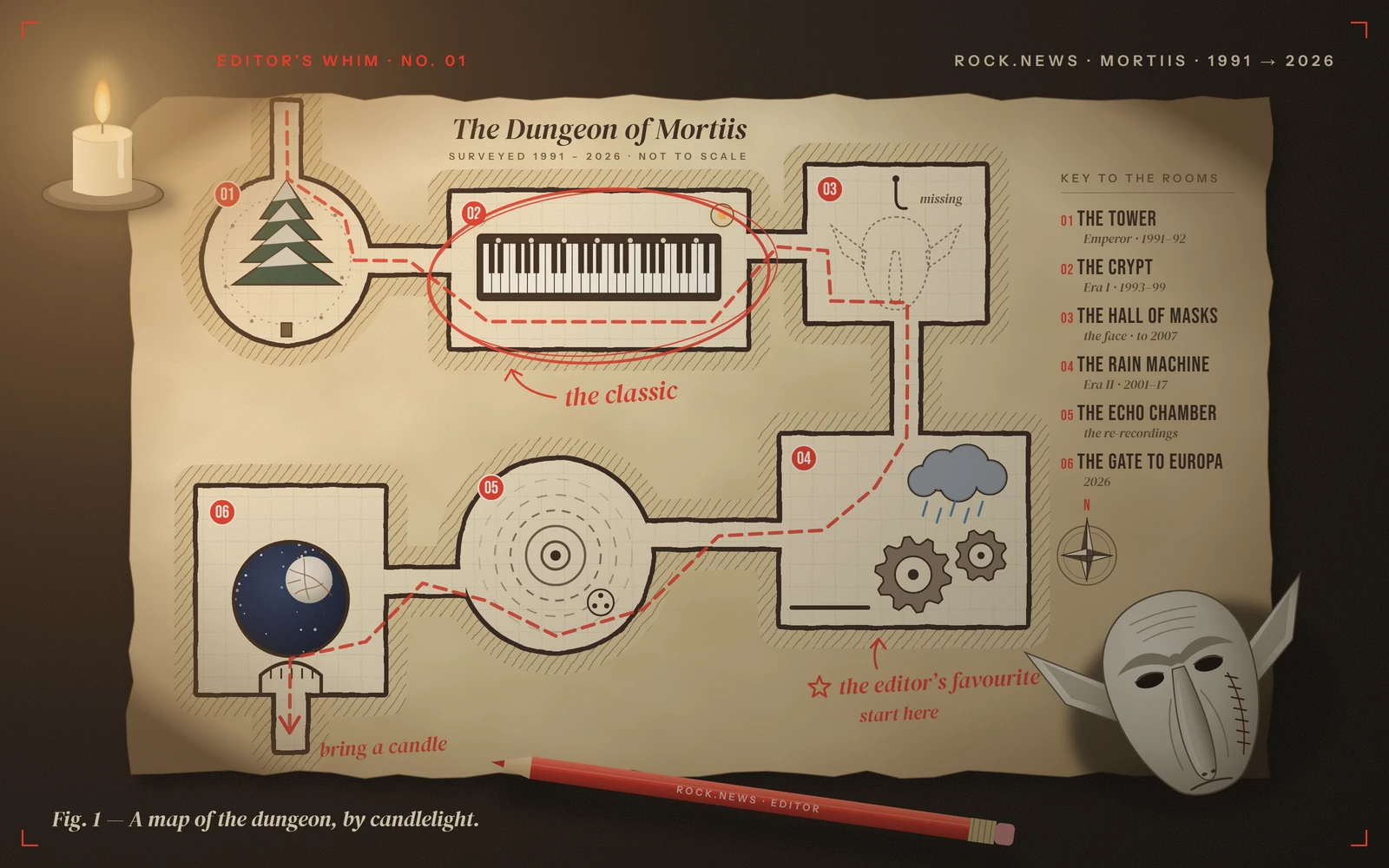
Every music site has a spreadsheet. Ours has several, and most of what we publish comes out of them: scores, consensus, charts, the occasional pie chart we are quietly proud of. This new series is the opposite. Editor's Whim is one artist the editor cannot stop playing, chosen for no better reason than that, and defended with the full irrational loyalty of a fan. We start with a man who was fired from one of the most famous bands in black metal, went home, plugged in a keyboard, put on a rubber goblin face and accidentally invented a genre. Then he took the face off, started singing and made the editor's favourite record of 2001. Thirty-odd years on, he has a new album, a year of touring behind him and a ticket back to the band that fired him. His name is Mortiis. Mind the stairs.
The Emperor years
The story starts with a bass guitar in the Norwegian winter of the early 1990s. Håvard Ellefsen, who would soon be known only as Mortiis (his own spelling of the Latin mortis, "of death", because one extra "i" is what separates a stage name from a Latin homework mistake), played bass in Emperor from about 1991 to 1992. This was the band of Ihsahn and Samoth, then teenagers, who were about to become one of the defining names of Norway's second wave of black metal.
His time there was short and loud. He played on the Wrath of the Tyrant demo of 1992, and on the band's self-titled EP, recorded in December 1992 and released by Candlelight in May 1993. Then he was out. How he left depends on who tells it. Mortiis himself has never dressed it up. "We recorded the mini-album and two hours later they fired me," he told Decibel in 2019. Two hours. Most of us have waited longer for a pizza. Other accounts mention his temper, or describe the parting as a band decision taken that December. Everyone agrees on the result: by the time the EP was in shops, its bassist was gone.
It is worth pausing on what was going on around them. The early Norwegian black metal scene would soon become notorious for reasons that had nothing to do with music, and the headlines from that period are grim. Being shown the door in 1992 put Ellefsen close enough to that world to understand it and far enough away to go and do something completely different. In the same interview he also revealed that Emperor had once planned a black metal cover of KISS's "Do You Love Me." It never happened. Somewhere in a parallel universe it did, and that universe is better than ours.
He says relations with Ihsahn and Samoth have been civil for years, even if they rarely talk. Remember that. It comes back at the end.
Dark dungeon music: the Era I albums
In 1993 Ellefsen started a solo project under his new name, and it did not sound like anything his old band would have recognised. There were no guitars and no drums. There was a synthesizer, a lot of reverb, and an imaginary world.
He called it "dark dungeon music." The genre name that grew out of it, dungeon synth, came later, but the blueprint was here: slow, looping keyboard melodies that sound like a castle soundtrack played on a cheap synth in a cold room, which is roughly what they were. Black metal had borrowed the imagery of medieval fantasy. Mortiis kept the castles and threw away the guitars, which in 1993 was a little like leaving a punk band to take up the harpsichord.
The run that fans now call Era I goes like this:
- The Song of a Long Forgotten Ghost (1993), the demo where it begins.
- Født til å Herske ("Born to Rule"), the debut album: one long piece split into two tracks of more than 25 minutes each. Pop singles were not the plan.
- Ånden som Gjorde Opprør ("The Spirit That Rebelled"), released through Cold Meat Industry, the cult Swedish dark ambient label: two long tracks, almost forty minutes in total.
- Keiser av en Dimensjon Ukjent ("Emperor of an Unknown Dimension", 1995). Yes, he called an album Emperor-something three years after Emperor fired him. We are choosing to believe this is a coincidence, and we are choosing to enjoy it anyway.
- Crypt of the Wizard (recorded in 1996).
- The Stargate (1999), where acoustic guitars, flutes and voices (most of them from soprano Sarah Jezebel Deva) start to come in.
You will notice we have left two dates out. That is not laziness. Født til å Herske and Ånden som Gjorde Opprør are each dated a year apart by different sources (1993 or 1994 for the first, 1994 or 1995 for the second), and the records' own pressings, with misprinted labels and reissues on several imprints, do not help. If anyone tells you the exact date with total confidence, ask to see their copy, then ask to see their other copy.
In the middle of the decade Ellefsen ran his own label, Dark Dungeon Music, while living in Halmstad on the west coast of Sweden. That detail sums up Era I nicely: a Norwegian who had left black metal and left Norway, putting out records about imaginary kingdoms from a seaside town better known for its beaches.
Why does it still work? Because it is so plain. These are not virtuoso pieces. The melodies are simple, the sounds are cheap and the tracks are far too long, and all of that is the point. Put Ånden som Gjorde Opprør on at night and the room gets bigger. It is music for reading, walking, and staring at a map of a place that does not exist. A whole generation of bedroom keyboard players has been making music like it ever since, many of them in capes.
The mask
Then there is the face.
For most of his career Mortiis performed in a prosthetic mask: a long, hooked nose, a heavy brow and pointed ears, with dreadlocks, body paint and studded leather around it. It was not a sticker-on Halloween mask but a cast prosthetic, which is why the studio that made it reportedly asked him for a character reference before moulding it. (Imagine the form. Name: Mortiis. Species: yes.) The result was neither a demon nor a corpse. It was a goblin, or a troll, or something from a fairy tale you would not read to children, and it made him one of the most recognisable figures in extreme music, which is quite an achievement for a man whose records had no drums.
The mask was never a joke, but it was always theatre. Black metal at the time was obsessed with being "real." Mortiis was openly, cheerfully fake: a character from his own fantasy world, standing on stage behind a fortress of keyboards. In hindsight it looks less like a costume and more like an early draft of what Ghost and Sleep Token would later turn into a mainstream business. He just did it with a bigger nose and a smaller budget.
And then he took it off. Slowly, and on purpose. In the Decibel interview he explains that by the late 1990s he was badly depressed, that the mask stopped fitting the music and the words he was writing, and that it simply "just wasn't needed anymore." This is the human part of the story, and it is worth reading slowly: the man behind the most famous rubber face in dungeon music was not having a good time behind it. During the touring for The Grudge, around 2004, he started removing the mask on stage, and on later artwork the face looked as if it was coming apart, held on by visible stitches. He wanted it to look as if there was a human being underneath. After the remix album Some Kind of Heroin in 2007, the mask was gone.
Not for ever, though. In October 2017 he wore it again for the Cold Meat Industry anniversary festival, and he has admitted that it took courage, because he was not sure it would still work. It did. The goblin was back, and frankly he looked well for his age.
The industrial turn
If Era I was a hermit in a tower, Era II was the same man walking into a nightclub, still slightly damp from the dungeon.
The Smell of Rain: the editor's favourite
Here we drop the pretence of neutrality. This is a whim, after all, and The Smell of Rain is the Mortiis album this editor would carry out of a burning building, possibly before the cat.
It came out on Earache in October 2001, and it must have arrived in a lot of homes like a letter from a relative who has joined a cult, except the cult was synth-pop. Gone were the forty-minute keyboard processions. In their place: nine songs of about four to seven minutes, with beats, distorted guitars, strings, female backing voices and electronic hooks you could, in theory, dance to, if you were the kind of person who dances in a black coat. And for the first time, Ellefsen sang lead vocals himself, in a low, dark baritone, a job that on The Stargate had mostly belonged to Sarah Jezebel Deva. (She did not go far: she is on this record too.) He arranged, produced, recorded and engineered it himself in Sweden.
The track titles alone are worth the price: "Scar Trek / Parasite God," "Flux / Mental Maelstrom," "Spirit in a Vacuum," "Monolith," "You Put a Hex on Me," "Everyone Leaves," "Marshland," "Antimental," and the closer, "Smell the Witch." It is the only tracklist we know that reads like a goth club flyer and a fantasy bestiary at the same time. "You Put a Hex on Me" is the best love song ever written by a troll. "Everyone Leaves" is the quiet heart of the record, and its title, coming from a man who had just walked out of his own genre, is either very sad or very funny, and on most days both.
Why did he do it? He has said he had grown disillusioned with his earlier sound and was listening to industrial bands such as Skinny Puppy and Nine Inch Nails. He was also, by his own account, depressed, and the lyrics are personal in a way the fantasy albums never were. The surprise is how melodic it all is. Mortiis has called that melodic streak a happy accident, which is the most Mortiis thing imaginable: he set out to make something harsh and ended up writing tunes. There is a nice detail in the booklet, too. The credits include a "John Prozac," and according to the album's Wikipedia entry, that is Mortiis himself, pictured without his mask. The man spent eight years hiding his face and then, when he finally showed it, gave it a fake name. Respect.
Not everyone was charmed. Writing in Ink 19 in early 2002, a self-declared long-time fan mourned that "the magic is gone," and compared the new sound to The Sisters of Mercy, Depeche Mode and Apoptygma Berzerk "dressed up like trolls." He meant it as a complaint. We would print it on a T-shirt. (And note the name Apoptygma Berzerk. Hold on to it. It comes back in 2026, in a way that reviewer could never have guessed.) The professional reviews were split: AllMusic gave the album three stars out of five, Rock Sound gave it four. A year later, a remastered edition added remixes, including work by the dark ambient veteran Lustmord, as if to reassure the old fans that the dungeon was still downstairs.
Twenty-five years on, the record has aged better than almost anything else from the nu-goth early 2000s. Its gothic synths now sound less like a betrayal and more like a bridge, and Mortiis seems to agree: in 2026 he built a whole tour around it (more on that below), and he has said his new album leans towards its sound. The fans who walked out in 2001 have, by and large, quietly walked back in, and some of them now claim they liked it all along. We remember. We are not going to say anything. We are just going to put it on again.
The Grudge, the charts, and the long goodbye
The Grudge (2004) went further: heavier, angrier, closer to industrial metal, with a full band behind him. It also did something no dungeon synth album had ever done. The single "The Grudge" gave Mortiis his first entry on the official UK singles chart, and the follow-up, "Decadent & Desperate," reached No. 49 in May 2005, and No. 3 on the UK Rock & Metal Singles Chart. For one week in May, a goblin from Norway was officially more popular than most of the people who had laughed at the nose. It still sounds like something we made up. It is not.
After that came the remix album Some Kind of Heroin (2007), Perfectly Defect (2010), given away as a free download, and a long silence after his last show in July 2011. When he came back, with The Great Deceiver (2016) and The Unraveling Mind (2017), the industrial Mortiis was intact: sharper, darker and still very much a band.
The two sides of Mortiis have never really made peace. Some fans love the dungeon and tolerate the drum machines; others are the other way round. That tension is the best thing about him. Very few artists have built two separate cult followings with one name, and fewer still have kept both of them grumbling happily for twenty-five years.
The re-recordings
Then he went back down the stairs.
The invitation to play Cold Meat Industry's anniversary in 2017 started a project that would take over the next few years. He did not just dust off Ånden som Gjorde Opprør; he re-recorded and expanded it. The result, Spirit of Rebellion, came out in January 2020: the same two long pieces, "A Dark Horizon" and "Visions of an Ancient Future," with a bigger, louder sound and touches of his industrial years. Decibel's reviewer judged that the new version came out ahead of the original, which is rarely said of a re-recording, and almost never said of a re-recording of a cult album by people who own the original on vinyl.
Since then he has treated Era I less like a museum and more like a living repertoire:
- In 2019 the original LPs of Ånden som Gjorde Opprør and Keiser av en Dimensjon Ukjent were repressed on coloured vinyl, as the originals had long sold out. A "From the Vaults" series of unreleased demos from his industrial years started around the same time.
- The early albums appeared on his official Bandcamp in remastered versions, alongside archive live recordings from 1997 and 1998.
- In 2023, ahead of its thirtieth anniversary, he re-created Født til å Herske for a North American tour in September 2024. He promised Lambgoat "wall-shaking sonics," which is a bold promise for music once made to be played quietly while reading Tolkien. In June 2024 he also released Crypt of the Wizard (Live), the 1996 album in concert form.
Many artists re-record old albums for legal or financial reasons. Mortiis seems to do it because he enjoys going back into the dungeon with better equipment. The old records were made on what he could afford. The new ones sound the way the old ones sounded in his head. It is the musical equivalent of finally buying the castle you drew as a child.
What he is doing in 2026
And here is the reason for this piece: 2026 has been one of the busiest years Mortiis has had in a long time.
A new album. Ghosts of Europa came out on 26 June on Prophecy Productions, his first record for the German label. It was recorded between 2020 and 2026 in Fredrikstad, Norway, and mixed by Sean Beavan, whose credits include Nine Inch Nails. And here comes the twist we promised. The album began as a planned collaboration with Stephan Groth of Apoptygma Berzerk, the very band that Ink 19 used in 2002 as shorthand for everything wrong with The Smell of Rain. The two bonded over a shared love of the German synthesizer pioneers Tangerine Dream and Klaus Schulze. When the collaboration ended, Mortiis carried on alone, and the Berlin-school sequencers stayed in. According to the album credits reported by Side-Line, Thorsten Quaeschning of Tangerine Dream plays synths and sequencers on the title track, and Sarah Jezebel Deva, his voice from The Stargate and The Smell of Rain, is back among the guests. He has described its making, a little wearily, as "a thousand sessions during years of misery, poverty, and disdain." It sounds like it was hard to make. It does not sound hard to love. The result is eight long tracks of electronic rock: part Smell of Rain, part dungeon, part sci-fi soundtrack. The reviews were good but not unanimous. Angry Metal Guy called it "sexy, spacy, and cinematic," which is not how anyone described Mortiis in 1994, while Blabbermouth gave it 7/10 and found the second half a little less brave than the first.
A tour of America. In spring Mortiis co-headlined the "Witches of Dystopia" tour of North America with Uada, with Rome and Wraith Knight in support, from Portland on 10 April to Seattle on 16 May. His sets leaned on The Smell of Rain, which turned 25 this year, and on new songs from Ghosts of Europa. For the first time in years he stood out in front as a frontman, not behind a wall of keyboards. After a few shows, he said, it felt as if nothing had changed since around 2010. We choose to take that as a compliment to the songs rather than a comment on the venues.
A homecoming. This is the part that made us start this series with him. In September 2025 the Bergen festival Beyond the Gates announced that Emperor would headline its 2026 edition with a special set featuring two former members: drummer Faust and Mortiis. The festival ran from 29 July to 1 August, with Emperor at Grieghallen, the concert hall whose studio is where the band recorded their classic albums. Thirty-four years after "two hours later they fired me," the bassist was back on the bill. That is the longest notice period in the history of rock. We have not found a reliable review of the night yet, so we will not pretend to know the setlist. The booking alone is the plot twist, and we suspect nobody asked for the KISS cover.
And Australia. Still ahead, as we write: the "Southern Ritual" tour, co-headlining with Nytt Land, with TiR as special guests, in Sydney (19 November), Brisbane (20), Melbourne (21) and Adelaide (22). It is his first Australian run with a full band, and a second Sydney show on 18 November has reportedly been added after the first sold out. Dungeon music, in the Australian summer. The goblin has finally found the beach.
Where to start
You do not have to hear everything. Here is the editor's route through the dungeon, in the order we would play it, with one shameless detour.
- The Smell of Rain (2001). Yes, we are starting with the favourite. Go in expecting a darkwave record, not a metal one, play "You Put a Hex on Me" and "Everyone Leaves" back to back, and see if you can stay neutral. We could not.
- Ånden som Gjorde Opprør (Era I). The classic. Two pieces, forty minutes, lights off. If the lo-fi sound puts you off, start with the 2020 re-recording, Spirit of Rebellion, and come back to the original later.
- Keiser av en Dimensjon Ukjent (1995). The grandest of the early albums, and the most cinematic.
- The Stargate (1999). The bridge: still a fantasy world, but now with voices, flutes and acoustic guitars. The album that tells you he was about to leave the dungeon.
- The Grudge (2004). The heaviest and angriest Mortiis, and the one with the chart hits. Start with "Decadent & Desperate."
- Ghosts of Europa (2026). Where he is now, and in places a cousin of The Smell of Rain. Start with the title track and its Tangerine Dream sequencers.
- Bonus: Emperor, Emperor EP (1993). To hear the bassist before he became a goblin, about two hours before he became unemployed.
Verdict: Mortiis should not have worked. A fired bassist with a cheap synthesizer and a rubber nose, making forty-minute songs about imaginary kingdoms, then leaving his own genre for the dance floor just as people started to love it, and singing about it in a voice nobody had heard before. Instead he gave black metal its quiet twin, pointed metal at theatre long before theatre was fashionable, made one of the great overlooked darkwave records of its decade, and in 2026 he is still writing new chapters while looking after the old ones. Behind the mask there turned out to be a person, a tired, stubborn and very human one, which is the best twist of all. He is not the biggest name in this series, and we doubt he will be the strangest. But few artists have built a whole world and then lived in it for more than thirty years. Take the stairs. Bring a candle. And when you smell rain, put on the record.
Sources and further reading
- Wikipedia: "Mortiis", "Emperor (EP)", "Født til å herske", "Ånden som gjorde opprør", "The Smell of Rain", "Dungeon synth".
- Decibel: J. Bennett, interview on masks, Emperor and the KISS cover (December 2019); album review of Spirit of Rebellion (January 2020).
- Vice: "Out of the Dungeon: In Conversation with Mortiis".
- Mortiis on Earache's Bandcamp: The Smell of Rain (tracklist); Ink 19 review of The Smell of Rain (January 2002); Orlando Weekly interview (April 2026).
- Official Charts Company: "Decadent & Desperate"; Blabbermouth on "The Grudge" single.
- Regen Magazine: Era I vinyl reissues and "From the Vaults" (October 2019); Lambgoat on the Født til å Herske tour (June 2024).
- Mortiis official Bandcamp: Ghosts of Europa, remasters and live releases; Side-Line on Ghosts of Europa (credits, recording, formats); PopMatters, Angry Metal Guy and Blabbermouth reviews.
- Metal Insider, V13 and Orlando Weekly on the Witches of Dystopia tour; Blabbermouth, Metal Injection and Beyond the Gates on Emperor with Mortiis and Faust; Noise11, Blunt and Metal-Roos on the Southern Ritual tour.
Editor's Whim is the editor's personal pick: no rankings, no data, just an artist we think deserves your evening. Next in the series: Alice Cooper and Type O Negative. Meanwhile, slow down with Slow Light: the doom records of 2026 or speed up with Total Chaos: the wildest records of 2026.
Artists in this piece Mortiis, Emperor, Apoptygma Berzerk, KISS, Sarah Jezebel Deva, Tangerine Dream, Faust, Ghost, Ihsahn, Nine Inch Nails, Samoth, Alice Cooper, Depeche Mode, Klaus Schulze, Nytt Land, Rome, The Sisters of Mercy, Skinny Puppy, Sleep Token, Stephan Groth, Thorsten Quaeschning, Type O Negative, Uada