À Cran — À Cran
Five Parisians, seven songs, eighteen minutes of Oi! sung in French. The fists and the beer are where you expect them. The surprise is how well these songs are written.
 By Huginn
Oi! is a genre with rules: short songs, loud choruses, the street, the pub, the gang. À Cran, a five-piece from Paris, keep every one of those rules on their self-titled album, and then do something the rules never asked for. They write songs with characters in them. In eighteen minutes you meet a skinhead crew with nothing to lose, a retired brawler pouring coffee and missing the fights, a soldier left in the mud by the country that sent him, and a football fan who died for something bigger than his club. The band's own motto is that Oi! is too serious to leave to respectable people. This record takes it seriously in the best sense.
Five pseudonyms and a demo
À Cran ("on edge" in French) recorded a six-song demo in February 2019 under five nicknames: Glinglin on vocals, Jacquesson and Kévain on guitars, Guigui on bass and Vin Chaud ("mulled wine") on drums. The album followed on 11 November 2020 on CROM Records, a small Franco-Spanish label for street punk. Most of its seven songs come from that demo, re-recorded and tightened, with two new ones added. It was recorded and mixed at Nathanaël's studio and mastered at North London Bomb, and the band put it on Bandcamp at name-your-price, under a Creative Commons licence. That is not a marketing plan. It is a way of saying the songs belong to whoever wants them.
The band's tags say where they come from: Paris, Oi!, skinhead, the eighties. The 1980s French Oi! scene is the language here: two guitars, short songs, choruses built for a room to shout back. Their Bandcamp bio ends with the letters S.H.A.R.P., Skinheads Against Racial Prejudice. In a scene where the haircut has been claimed by the wrong people more than once, that line matters, and the songs back it up.
Seven songs, seven people
The opener, "Frappe (un pour tous, tous bourrins)", takes the Three Musketeers' motto and swaps the noble ending for "brutes": all for one, and all of us thugs. It is a minute and a half of crew loyalty, and the joke in the title tells you the band know exactly how they look from outside.
"Cadillac" is the first great song. Its hero is a former street fighter with a nickname, a drinker who looks like a beer-soaked Johnny Hallyday and now works a dull job in a café. He misses the fights. The song neither mocks him nor makes him a legend. It is a short story about the day after the glory years, the kind of portrait that usually turns up in chanson, not in Oi!.
"Gueule Cassée" goes back a century. The gueules cassées were the French soldiers of the First World War who came home with their faces destroyed, and the song puts one of them in the trench mud, broke and abandoned by his comrades and by the state that sent him. It is the first sign that this album has a historical memory. The last song confirms it.
"Onzième" is the local anthem every Oi! band owes its neighbourhood: the 11th arrondissement of Paris after dark, its bars, its streets by name, the shaved heads who think they run it. It is the album's most traditional song, and it works because it is so specific.
Law, acid and the road to glory
The second side gets darker. "La Loi", sung with a guest, Ed CRAN, is about young people who feel written off before they start, and it slips a reference to Sartre's Huis clos in among the anger at the police. "Acid Violence" is that rare thing, a punk song against drugs that does not preach: it admits the high of a wild night, then counts what it costs, and its chorus mixes French with deliberately broken English.
The closer, "Les Sentiers de la gloire", is the best thing here and the longest, at 3:39. The title is the French name of Kubrick's anti-war film Paths of Glory, and the song is a tribute to a fallen Red Star fan, the Saint-Ouen club of the working-class north of Paris, tying football, class and anti-fascist resistance into one story. A pun on balle, both ball and bullet, holds the whole idea in one word. A band that opens with a joke about being brutes ends with a song about memory and sacrifice, and the eighteen minutes in between make that turn feel earned.
The reservations
This is not a record that reinvents Oi!, and it does not try to. The form is the classic one, and if shouted choruses and street-punk guitars are not your music, seven good lyrics will not change your mind. The music does its job and serves the songs, but it rarely surprises you the way the words do. And at under nineteen minutes, with five of the seven songs already heard on the demo, it feels more like a first chapter than a full statement. The band's later songs, on a 2022 single and a 2023 split, suggest the story was still being written.
Start here
- À Cran, "Cadillac". A retired café brawler in under three minutes: the best character song on the record. Cadillac
- À Cran, "Gueule Cassée". The First World War seen from the trench mud, with the band's anger turned on the state. Gueule Cassée
- À Cran, "Onzième". The neighbourhood anthem: the 11th arrondissement of Paris after dark, street by street. Onzième
- À Cran, "Les Sentiers de la gloire". The closer and the longest song: football, class and resistance in one story. Les Sentiers de la gloire
The cover
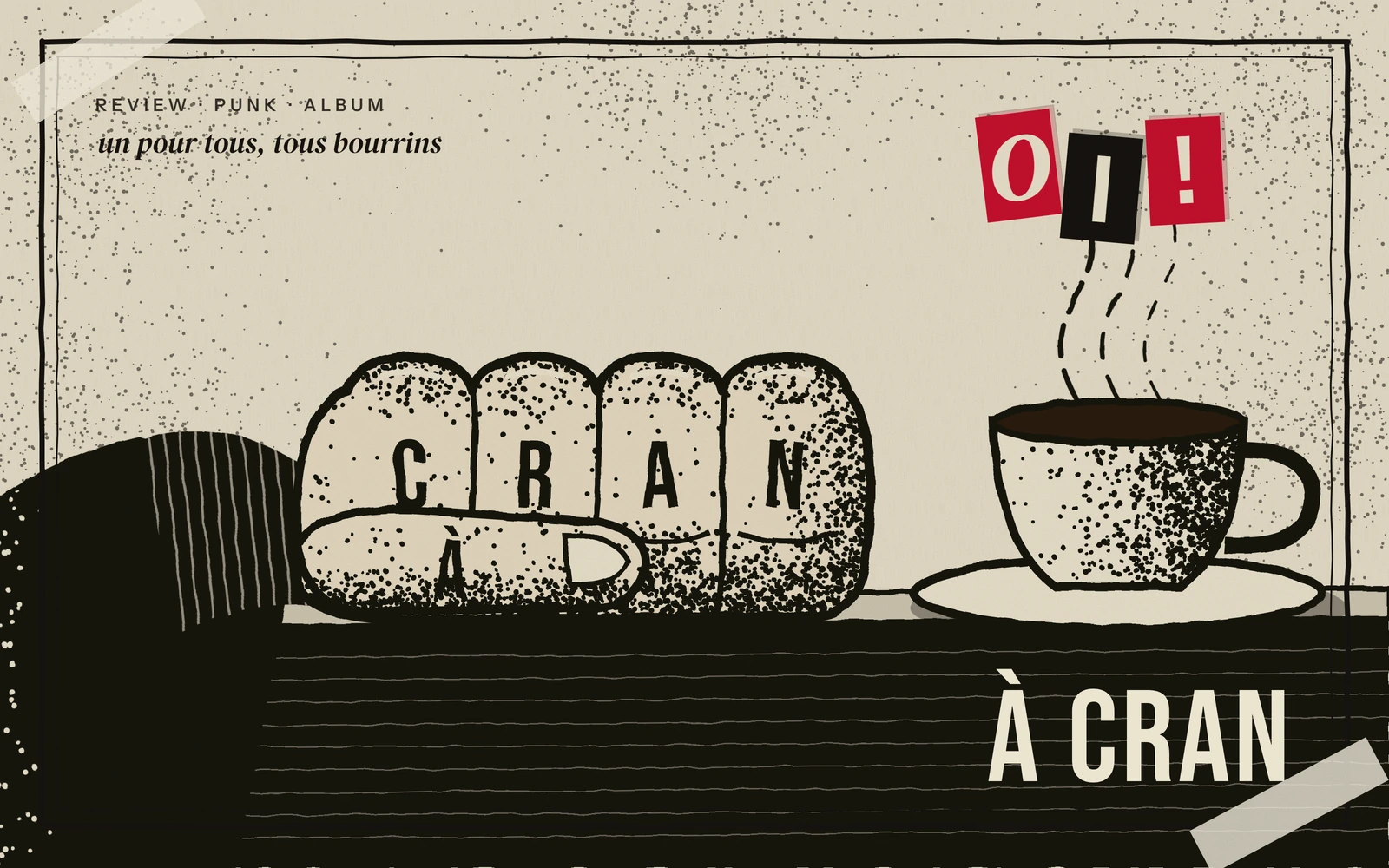
The illustration at the top of this review is our own original image, not the album's sleeve. We drew it as a photocopied fanzine flyer in black-ink dotwork, the way old Oi! gig flyers and tattoo flash were drawn, and built it from the record's characters: the retired brawler of "Cadillac", now behind a café counter, his fist on the zinc with the band's name across his knuckles, and an espresso where the pint used to be.
Verdict
7.5/10rock.news review score · how we score
Verdict: À Cran plays Oi! by the book and writes it better than the book requires. The music is the classic Paris street sound; the stories are what lift it, from the brawler in "Cadillac" to the soldier in "Gueule Cassée" and the fallen fan in "Les Sentiers de la gloire". It is short, it is not original in form, and it will not convert anyone who finds Oi! narrow. But if you understand French, or are willing to read along, it is one of the most human records the genre has produced in years, and it costs whatever you decide to pay for it.
À Cran came out in 2020, before the period our rankings cover. For the year's best-rated punk records, see Punk 2026.
Artist page À Cran