Disfear — The Last Nail
Fourteen years of writing, three years of recording, two funerals before release. The Swedish d-beat veterans built their last stand out of songs about disease and death that were written before the disease arrived. It hits like a fist and lands like a letter.
 By Huginn
In the spring of 2023 Tomas Lindberg walked into a studio in Gothenburg to fix a few lines on the demo vocals for Disfear's new songs, and walked out having sung all eight of them again from scratch. Later that year he was diagnosed with cancer; in September 2025 it killed him. The band's drummer, Marcus Andersson, had been fighting a brain tumour since 2022, and he died two months before release. So The Last Nail arrives as a record about death, disease and the end of things, by a band that has lost three of its own to cancer. The remarkable thing is how little it sounds like a memorial. It sounds like a band in the red, going as fast as it can, with nobody yet looking back.
Eighteen years between nails
Disfear came out of Nyköping, south of Stockholm, in 1989, as one of the Swedish bands who took the hammering two-beat of Discharge, the d-beat, and made a national dialect of it. Lindberg, the At the Gates singer, joined in 1998, and with him the band hit its stride: Misanthropic Generation in 2003, then Live the Storm on Relapse in 2008, with guitarist Uffe Cederlund, formerly of Entombed, newly on board and Kurt Ballou recording. That album turned crust punk into something with a swing, a Motörhead swagger under the riot.
Then came the long silence. Founding bassist Henke Frykman died of cancer in 2011, and the band decided after his funeral to keep going. The first song they wrote after that decision, in 2012, is the one that closes this album and gives it its name. The rest came slowly, over fourteen years of writing and three of recording, around day jobs, other bands and illness: Lindberg's vocals in Gothenburg in 2023, drums and guitars with Ballou at God City in Salem, Massachusetts, in July 2024, bass and backing vocals at Welfare Sounds in Gothenburg in April 2025, and a mix by Magnus Lindberg in Stockholm early this year. Andersson asked the band to keep the release date. He saw the finished record. He did not live to see it come out.
What it sounds like
Short, first of all: eight songs, thirty-five minutes, no intro, no ballad, no spoken farewell. The opening pair, "A Circle of Disease" and "Early Graves", are pure d-beat at full gallop, the drums hammering that lopsided two-step that has driven Swedish punk for forty years, the guitars thick with the buzzsaw grit of the old Stockholm death metal sound. Cederlund's presence is all over the record: the riffs carry more melody and more hooks than they did in 2008, and the leads come out of the noise like sparks off a grinder.
What keeps it from being a forty-year-old formula played well is the looseness. Disfear have always had a rock'n'roll streak, and here it runs right through: "Early Graves" moves with a Motörhead drive under its Discharge rawness and has a chorus you can shout back on first hearing. The mix gives each instrument room, so the bass is a voice rather than a rumble and the drums sound like a man hitting things rather than a machine. Ballou recorded Live the Storm too, and the two records share a punch; The Last Nail is a little less crushing and a lot more lively.
And over all of it, Lindberg. He sang these songs before he knew he was ill, and you can hear a man with nothing to save his voice for: a raw, ripped bark that sits right on the edge of breaking, never once decorated. He was one of the most recognisable screamers in heavy music, and he spends his last record not as the star of a famous metal band but as the shouting front man of a punk band from a small town. It suits him perfectly.
Songs about death, written before it came
The lyrics were written long before the diagnoses, and they deal with death, disease and darkness: the fragility of the world, the systems that steer us, the comforts that keep us quiet. Read now, titles like "A Circle of Disease", "Early Graves" and "The Revenant" feel almost unbearable. The band does not lean on that, and neither should a listener. Crust punk has always sung about disease and the grave, because it sings about war and the world that makes them; these are protest songs, not premonitions. But the coincidence gives the record a weight it could never have planned.
The second half is where Disfear loosen the collar. "Shackled to Our Vice", the second single, is the rockiest thing here, built on swagger rather than speed. "Cyanide", at just over five minutes the longest song, burns with a bluesy edge and moves from Lindberg's howls to gang shouts before stamping to a heavy, molten finish. "Open to the Night Within" and "Oblivion Bound" shift tempos and let the leads wind around the beat, the most metal moments on a punk record.
Then the closer, "The Last Nail in the Last Coffin on Earth". It is the oldest song on the album, written in 2012 as the band's first act of carrying on, and its target is not death but consumption: a world spending itself into the grave. It opens on the drums, Andersson pounding the kit, rides a chorus built for a packed basement and ends in a big guitar solo, with Lindberg's last screams on the record behind it. The band did not write it as an epitaph. It has become one anyway, and it carries the weight.
The reservations
This is d-beat, and d-beat is a narrow language by choice: the same beat, the same buzzsaw, the same bark, thirty-five minutes at a time. The Last Nail speaks it with more melody and more rock'n'roll than most, but it does not stretch it, and a listener who has never loved the style will not be converted. The middle of the record blurs a little; "Oblivion Bound" and "The Revenant" hit hard and leave few marks. And it is impossible, now, to hear any of it without the story. Take the deaths away and this is a very good punk record by veterans in top form, not a reinvention. That is no small thing. It is just not the same as a new idea.
Start here
- Disfear, "Early Graves". Motörhead drive and Discharge rawness in four minutes, with a chorus to shout back: the record in miniature. Early Graves
- Disfear, "The Last Nail in the Last Coffin on Earth". The oldest song and the closer, written in 2012 after a funeral, carrying Lindberg's last screams on the record. The Last Nail in the Last Coffin on Earth
- Disfear, "Cyanide". The longest track: bluesy, burning, with a heavy molten ending. Cyanide
- Disfear, "A Circle of Disease". The opener at full d-beat gallop, and the sound of a band with no time to waste. A Circle of Disease
The cover
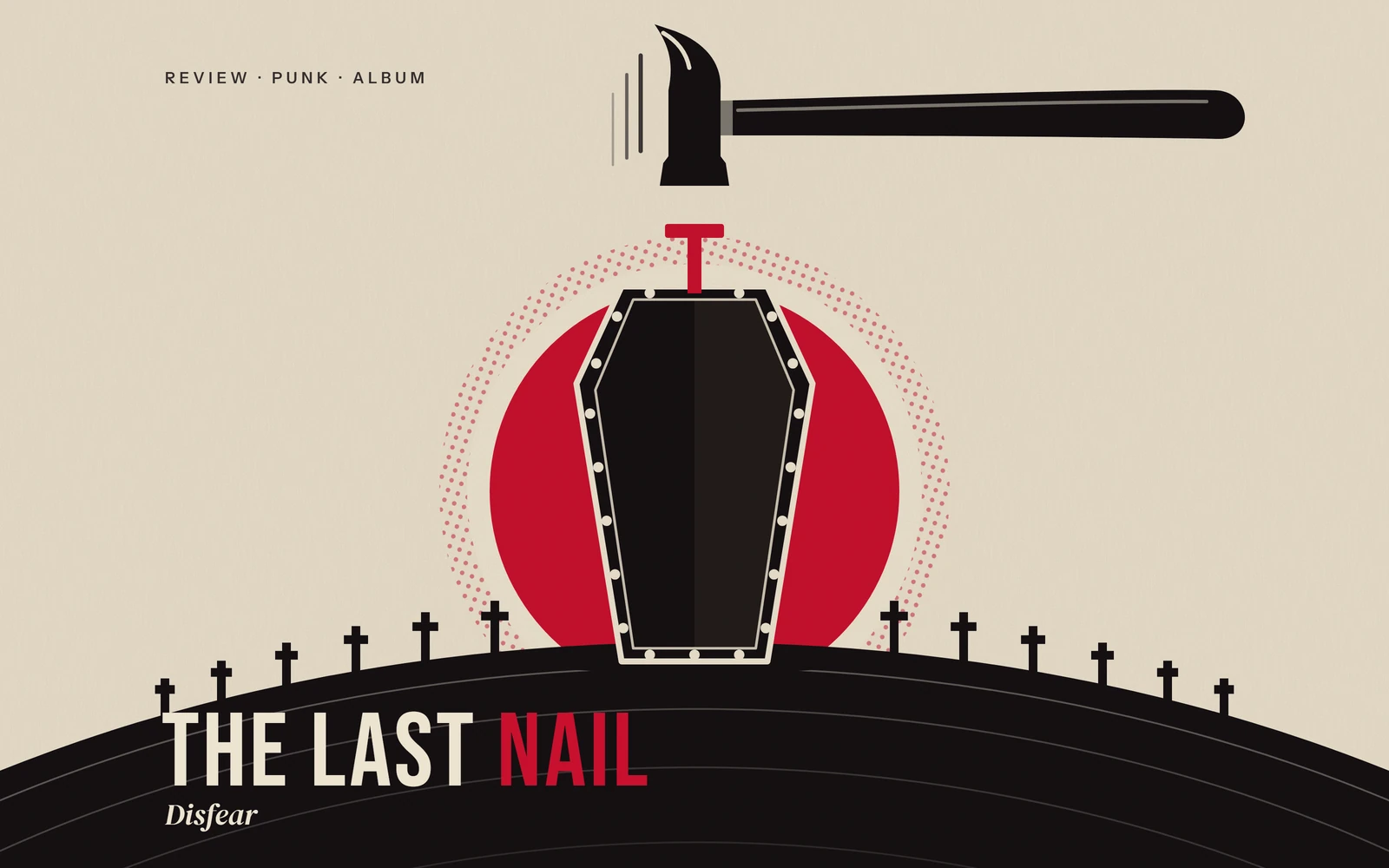
The illustration at the top of this review is our own original image, not the album's sleeve. We drew it as a two-colour punk poster, black and red on cheap cream paper, and took the closing song's title literally: the last coffin on Earth, standing on the curve of the globe between rows of early graves, its rim already full of nails, and a hammer coming down on the last one.
Verdict
8.0/10rock.news review score · how we score
Verdict: The Last Nail is the rare farewell that does not know it is one. Disfear wrote and sang these songs as a living band, angry at the world, and that is how they play: fast, loose, melodic in the gaps and furious in the middle, with Tomas Lindberg tearing his voice open on every line. The style is old and the record does not try to change it, but it is played with such heart and recorded with such life that the formula hardly matters. Start with "Early Graves", end where the album ends, and turn it up for Tomas, Marcus and Henke.
No ranking score yet: the album came out after the window of our first-half rankings, so the score above is our review score alone.
The Last Nail came out after the window of our first-half rankings, so it is not in our rankings yet. For the year's best-rated punk records so far, see Punk 2026.
Artists in this piece Disfear, Discharge, Motörhead, At the Gates, Entombed