Ignea — Monumental
Kyiv's most cinematic metal band put away the spice-road melodies and walk into the ruins of the first space age. The result is their strangest and best record: nostalgia played as a disease, with a theremin for a fever chart.
 By Huginn
In the winter of 2025, Kyiv lived by power-outage schedules, and Ignea had to heat their studio for about three hours before the microphones would work. Out of that cold came a record about warmth that is gone: the rockets, mosaics and concrete housing blocks of a future that was promised and never arrived. Monumental is the Kyiv band's fourth album and the first one that sounds like nobody else. It is not always comfortable, and it does not always land. It is never boring.
Leaving the desert
For ten years Ignea had a sound you could pick out in five seconds: melodic death metal with orchestras on top and Middle Eastern scales running through it, and a singer, Helle Bogdanova, who goes from a clear, high melody to a full roar inside one line. It was a good sound, and a safe one. The band could have made that record again.
They didn't. Keyboard player, main composer and producer Yevhenii Zhytniuk shelved the songs with folk colour, and only one track here keeps the old Eastern motifs. In their place come arpeggiated analog synths, keyboard tones that sound lifted from a 1960s science-programme jingle, and a theremin, the instrument that played every flying saucer in every old film. The riffs of guitarist Dmytro Vinnichenko and bassist Oleksandr Kamyshyn, over Dmitry Kim's drums, are still there, and still heavy. But the air around them has changed from desert heat to cold neon.
A future that never came
The subject is nostalgia, and the band treat it the way 17th-century doctors did, when they first gave it a name and filed it as a disease. Helle wrote every lyric, and the brief she set herself is sharper than most concept albums get: not nostalgia for the space age itself, but for an aesthetic that was already looking back when it was built. Cosmonauts on posters, mosaics of rockets on the walls of provincial museums, prefabricated tower blocks designed to make everyone's life the same. The future as it was imagined in 1965, now crumbling at bus stops across Ukraine.
The British writer Mark Fisher called this kind of thing hauntology: the ghosts of futures that were cancelled. You don't need to know the word. You only need to hear "Dreams of Lands Unseen", where a driving riff and a growl give way to shimmering keys and then a theremin solo that sounds like a radio signal from a probe that lost contact decades ago. The song even carries the title of the band's previous album, as if Ignea were digging up their own past along with everyone else's.
It matters where this was made. The band's offices sit at the Dovzhenko Film Studios in Kyiv, whose costume workshop rented them real vintage cosmonaut helmets and suits for the "Dreams of Lands Unseen" video. On the night of 14 to 15 June 2026, a Russian strike destroyed that workshop, with its archive of some 100,000 costumes, and damaged Ignea's headquarters. A record about monuments to a dead empire's dreams, built in a city that the empire's heir is still trying to destroy: you could not invent a sharper frame, and the band never once spell it out. That restraint is part of the strength.
Concrete and neon
The album's centre is a three-song run that shows how far the band have travelled. "Prefab" is an industrial stomp about the panel housing blocks that stripped millions of flats of anything personal, and Andy LaPlegua of Combichrist barks across it like a foreman on a building site. It is the closest Ignea have come to a dance floor, and it works because the riff is too ugly to be a pastiche. Then "What Buildings Dream Of", the most playful thing they have recorded: electronic, proggy, a little odd, with the title doing half the poetry. Then "I Am in Hell", a song Helle wrote back in 2020, set as a synth lullaby. A calm, almost sweet melody carries words about the end of the world, and the gap between them is the most unsettling moment on the album.
"Presence of the Past" is the record in miniature: heavy riffs, Helle humming over them, the theremin again, and a fairytale swell about loving old buildings while the city demolishes them around you. "Between No Longer and Not Yet" is the one track that keeps the Eastern scales, slowed down to doom and smoked through something like dark jazz; its subject is escaping a bad present by putting on an old record, which is exactly what it feels like.
"Harmony Manufactured", with guest vocals from Britta Görtz of Hiraes, is the heaviest and fastest song here, and its subject is the clean, mass-made objects of modernist design that turned into collectibles. The short instrumental "Nadir" closes the album by reworking melodies from the opener, a slow fade over the skyline.
Where it falls short
Not every experiment has teeth. Opener and single "Darkness" is all shimmering synths and layered harmonies, beautiful and a little too polite for a first track: the album's argument starts properly one song later. Fans who came for the spice-road melodies of the earlier records will miss them, and there are moments when the keyboards fill every corner and the band underneath has to fight for room. Jacob Hansen's mix and master is crystal clear, which is a gift to the voice and the synths.
And for a record this full of ideas, nine songs in 42 minutes, one of them a two-minute instrumental, is short. Some of these songs end just as they start to open a door.
Start here
- Ignea, "Dreams of Lands Unseen". The new sound in one song: a death-metal riff, a cold synth sky and a theremin solo from a lost space probe. Dreams of Lands Unseen
- Ignea, "Prefab". Industrial metal about panel housing blocks, with Andy LaPlegua of Combichrist as the foreman. Prefab
- Ignea, "I Am in Hell". A lullaby about the apocalypse: the quietest and most unsettling track on the album. I Am in Hell
- Ignea, "Between No Longer and Not Yet". The last of the Eastern scales, slowed to doom and dark jazz. Between No Longer and Not Yet
- Ignea, "Harmony Manufactured". The heaviest song, with Britta Görtz of Hiraes. Harmony Manufactured
The cover
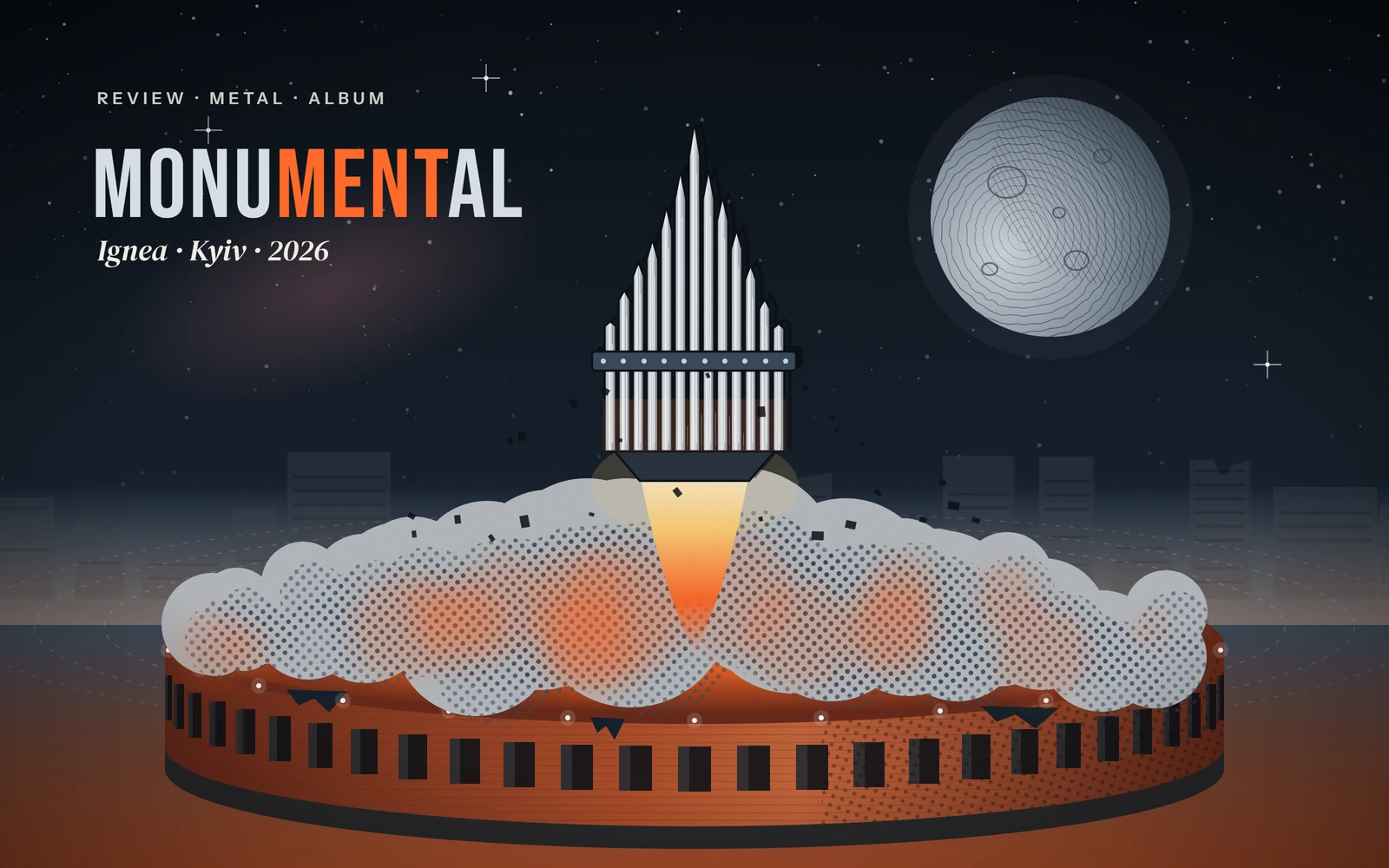
The illustration at the top of this review is our own original image, not the album's sleeve. The sleeve, a reworked photograph by Ignea's long-time visual team Lame Perfect, stands at night inside the courtyard of a round modernist museum in Shepetivka, under a planet, with a steel spire at its centre: a fragment of the facade of the old Kosmos cinema in Zhytomyr, taken down days after the band chose it. A monument to a future that never came, left standing in the dark.
We drew the next scene. At first light, seen from outside the ring, the spire finally does what it was always shaped to look like and lifts off, smoke pouring over the rusted rim and the fogged city watching. We drew it as an old space-age print poster, in flat colour, halftone and an off-register rust pass, the graphic language of the posters that once sold that future. It is a picture of a dream leaving the ruins, which is what the best songs on Monumental do too.
Verdict
8.5/10rock.news review score · how we score
Verdict: Monumental is the sound of a good band refusing to repeat itself. Ignea swap the exotic scales that made their name for theremins, analog synths and the concrete ghosts of the first space age, and build a whole record about the future that never came, while their own city lives through the present it got instead. The opener is too gentle and the album ends too soon, but its best songs, "Prefab", "I Am in Hell" and "Dreams of Lands Unseen", sound like nothing else in metal this year. Strange, cold, unexpectedly moving: their best album.
Monumental came out after the window of our first-half rankings, so it is not in our rankings yet. For the year's best-rated metal records so far, see Metal 2026; for the rest of the Ukrainian heavy scene, see Noise Atlas: Ukraine.
Artist page Ignea