Noise Atlas: Ukraine
A new series of scene reports, one country at a time. Stop one: a heavy scene that kept rehearsing through blackouts, toured abroad to raise money for home and sent its singers to the front. Björn draws the route from Horlivka to Uzhhorod.
 By Björn
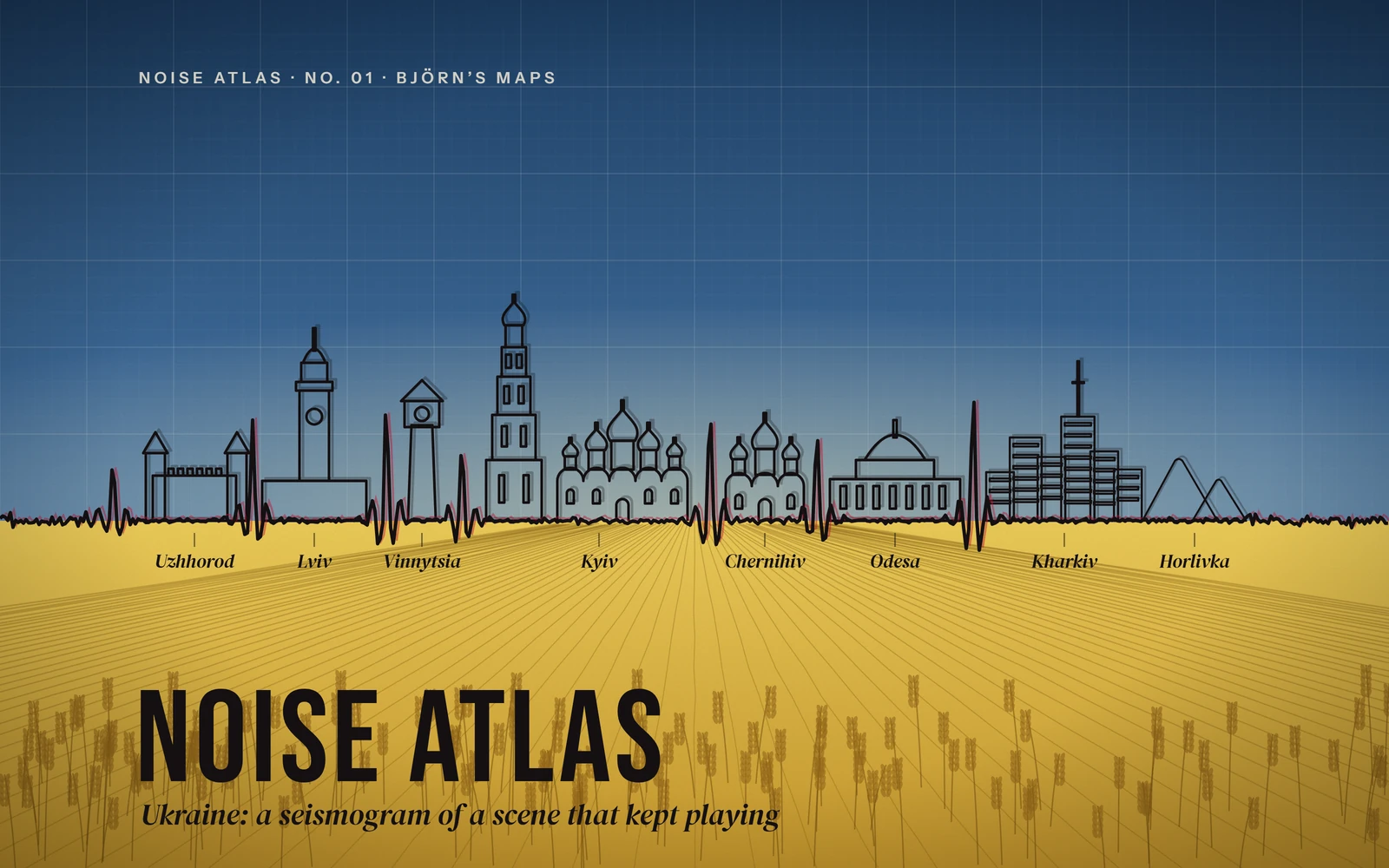
Welcome to Noise Atlas, a new series in which I fold out a map of one country's heavy music and walk it, pin by pin. Every stop gets a city, a few lines on why the act matters, and a start-here pair: one album, one track. I begin with Ukraine, because no scene has had a stranger few years to keep playing through. Its musicians have rehearsed in blackouts, recorded in a film studio that was later hit by a missile, played abroad to send money home, and in many cases put the guitar down to serve. The route runs east to west, from Horlivka to Uzhhorod: about 1,150 kilometres as the crow flies, rather more by train.
How to read this atlas
Each pin is a city where an act was born or is based. The route goes east to west, because that is roughly how a lot of Ukrainian musicians have had to move since 2014. Under every act you get two things: the album to start with and the one track to play first. Song titles in Ukrainian are transliterated, with a translation in brackets the first time. The scope is the heavy end in the broad sense: metal, post-metal, doom and stoner, hardcore and punk, and two acts that are heavy in mood rather than in distortion. I'll argue for them when we get there.
Before the map
Ukrainian rock has a start date that a geek like me can love: 30 October 1987, when Vopli Vidopliassova played their first show at the Kyiv rock club. The band had formed the year before. In the late Soviet years, a rock club was one of the few places where a band could play its own songs in Ukrainian, and a lot of what came after started there.
Through the 1990s and 2000s the heavy underground grew where it usually grows: in industrial cities with cheap rehearsal rooms and long winters. Kharkiv became the capital of a black metal scene that was mostly known abroad through tape trading. Crimea, of all places, held one of the country's big metal festivals, Metal Heads' Mission.
Then 2014 redrew the map. Crimea was annexed and the festival went with it. In the east, the war in Donbas reached Horlivka, the home town of a young metalcore band called Jinjer. They left, moved west, and by 2017 had settled in Kyiv. Hold on to that move: it is the first line on this route.
2022: playing under martial law
I'll put the helmet down for this section.
Since 24 February 2022 the country has lived under martial law. Air-raid alerts interrupt rehearsals and gigs, power cuts set the studio hours, and men of fighting age cannot simply pack a van and leave. Every Ukrainian band you have seen on a Western stage since then has had to work around all of that.
Many musicians went the other way, into the army. The frontman of DK Energetyk was mobilised in March 2025, on the eve of a concert. Andriy Zholob of the Lviv punk band Beton, a trauma surgeon in civilian life, was drafted in May 2022 and commanded a brigade medical company. One of 1914's guitarists joined the army just before the sessions for their latest album. Dmytro Odnorozhenko of hatespeech now hunts Shahed drones with an unmanned systems unit. Mykola Sostin, known as Amorth, who played drums for Drudkh in the mid-2000s, joined the army in August 2024 and was killed near Pokrovsk that autumn. He was 39.
The rest of the scene turned into a fundraising machine. Jinjer's charity T-shirts raised more than $140,000 in the first weeks of the invasion. Faine Misto, the country's big rock and metal festival, moved from Ternopil to Lviv and now runs as a charity event. Bands play benefit shows abroad and send the money home, and a few have toured inside the country with every ticket counted as a donation. And the war reached the studios: on the night of 14 to 15 June 2026, a Russian strike damaged the Dovzhenko Film Studios in Kyiv, where Ignea have their offices and the studio where they had recorded their new album.
None of this is a backdrop. You can hear it in almost every record below.
The atlas
Pin 1. Horlivka → Kyiv → everywhere: Jinjer
The first pin is a moving one. Jinjer started in Horlivka, rebuilt in Kyiv and now live across three countries: singer Tatiana Shmayluk in California, two members in Warsaw and one in Bulgaria. Their progressive metalcore swings between a jazz-club groove and a full-throated roar, often inside one bar, and Shmayluk switches between clean singing and growls more easily than most people switch lanes. Their latest album, Duél (2025), was recorded in Warsaw, and the band have described "Tumbleweed" as a song about refugees.
Start here: King of Everything (2016) · Track: "Pisces", the song that turned a Ukrainian band into a global one: soft, almost bossa-nova verses, then a scream that seems to come from another singer entirely.
Pin 2. Kharkiv: Drudkh
Kharkiv, 30 kilometres from the Russian border, has been shelled for most of the full-scale war, and it is still the home of Ukraine's most famous black metal band. Drudkh, formed in 2002 by Roman Saenko and Thurios, play long, slow, atmospheric black metal built from folk melodies and the poems of Ukrainian writers. They have never toured and almost never give interviews; they put out records and let the forests on the covers do the talking. They have not slowed down: Shadow Play came out in 2025 and an EP from the same sessions, Thaw, in April 2026. Their old drummer Amorth, who played on three of their early albums, was killed at the front in 2024.
Start here: Autumn Aurora (2004) · Track: "Summoning the Rain", the opener: a slow, rainy riff that keeps circling back until it feels like weather.
Pin 3. Chernihiv: Sumakh
Chernihiv was besieged in the first weeks of the invasion. Sumakh formed there in the autumn of that year and play post-black metal: blast beats wrapped in long, sad guitar lines. Their album Brink of Existence (2025) deals with the war directly. A small pin, but a new one, and new pins are the point.
Start here: Brink of Existence (2025) · Track: "Doomsday", the opener
Pin 4. Kyiv and Brovary: the capital cluster
Kyiv is the biggest dot on this map, so it gets a zoom.
Stoned Jesus. Igor Sydorenko started the band in 2009 as a stoner-doom project and turned it into Ukraine's best-known heavy rock export: by the band's own count, they were the first Ukrainian rock band to tour South America, in 2017. Sydorenko left Kyiv on the second day of the invasion and came back. The band rehearsed again in July 2022 and have toured abroad ever since, raising money for home. They are now in the middle of a trilogy: Songs to Sun (2025), Songs to Moon (October 2026), with Songs to Earth due in 2027.
Start here: Seven Thunders Roar (2012) · Track: "I'm the Mountain", a stoner song of almost 16 minutes that climbs slowly and is worth every metre.
Ignea. Melodic death metal with orchestras and Middle Eastern scales, and a singer, Helle Bogdanova, who can do both the aria and the roar. Their new album Monumental (October 2026) was recorded mostly in the winter of 2025 to 2026, in a city living on power-outage schedules, at the studio that was later hit by that June strike.
Start here: The Realms of Fire and Death (2020) · Track: "Jinnslammer"
DK Energetyk. Not metal, and I know it. This is Ukrainian-language post-punk and coldwave from Brovary, just east of Kyiv, formed in early 2022 and named after the Energetik Palace of Culture in Prypiat, the abandoned town next to Chornobyl. It is heavy the way a Soviet apartment block is heavy: grey and cold, built to last. The video for "Enerhetyk" was filmed in the Exclusion Zone and dedicated to power engineers killed by Russian attacks. Their 2026 EP 86.4 FM was recorded live in Prypiat for the 40th anniversary of the disaster. In late 2025 they toured Ukraine with the 3rd Army Corps, and every ticket went to the corps' fund.
Start here: Kvadraty (2025) · Track: "Enerhetyk" ("Power Engineer")
Zwyntar. The second act that bends my scope, and the one I'd defend hardest. The name is the Ukrainian word for "graveyard". They play dark country and gothic folk: a banjo, a washboard and a singer who tells the old Ukrainian folk tales with the horror left in. There are no blast beats, and it is one of the darkest things on this map. The band give their concert proceeds to charity, and recorded "Zoloto i blakyt" ("Gold and Blue") to buy an armoured vehicle for the army.
Start here: Na inshomu botsi riky ("On the Other Side of the River", 2025) · Track: "Potiah na Pivden" ("Train to the South")
Death Pill. An all-female hardcore punk and thrash trio, formed in Kyiv in 2017. Their debut album came out on 24 February 2023, a year to the day after the invasion. It was recorded before the war and mixed during it. A London label found them through a benefit compilation. The members are now split between Kyiv, Spain and Australia, and the second album, Sologamy (2025), is fast and furious all the same.
Start here: Sologamy (2025) · Track: "Craterface"
Vøvk. A trio playing progressive post-hardcore with post-metal weight, and singing in Ukrainian. On their album Litera (2025), Johannes Persson of Cult of Luna sings a guest part in Ukrainian on "Promin" ("Ray"). Getting the vowels right is a long way to come for a guest spot.
Start here: Litera (2025) · Track: "Promin"
Also in the capital, small print on the map. hatespeech (lowercase, as they write it) formed in 2022 and mix alt-rock, punk and trap. Their frontman now serves in the army. Dity Inzheneriv ("Engineers' Kids") played loud grunge-punk until they went on a long pause in 2025, with a farewell show in Kyiv. Boanthropy play slam: the slowest, lowest corner of death metal, where the breakdowns tour at walking pace. Their single "Sanity Check" came out in March 2026.
Pin 5. Vinnytsia: Space of Variations
Space of Variations are from Vinnytsia. Plenty of lists put them in Kharkiv, and they are wrong, which is the most cartographer sentence I will write today. They play modern nu-metalcore, all syncopated riffs and huge choruses, and they have twice been named the best Ukrainian metal band at the country's national music awards. The war delayed their Napalm Records debut twice. Their third album, Poisoned Art (February 2026), was, in the band's words, written during the darkest period of their lives.
Start here: Poisoned Art (2026) · Track: "HALO"
Pin 6. Odesa: White Ward and Mortui Vultus
White Ward play post-black metal with a saxophone in it, and it works better than it has any right to: blast beats give way to smoky, late-night jazz and back again, like a harbour city at 3 a.m. Their third album, False Light, came out in June 2022, four months into the full-scale invasion.
Start here: Love Exchange Failure (2019) · Track: "Poisonous Flowers of Violence"
Mortui Vultus formed in Odesa in 2022 and play post-black metal too. Their album Distant Echoes (2025) was recorded during air-raid alerts and shaped by the deaths of friends in the war.
Start here: Distant Echoes (2025) · Track: "Outmoon"
Pin 7. Ivano-Frankivsk: KARNA
KARNA call their music Hutsul metal, after the highlanders of the Carpathians, and that is exactly what it is: nu-metal riffs with mountain fiddles, folk melodies and a sense of humour. They have been at it since 1997. Some members joined the army or the territorial defence after 2022, others drove supplies to the front, and part of their concert money goes to the military. "Mama Halychyna" ("Mother Galicia", 2022) is dedicated to a soldier killed at Popasna.
Start here: Hutsulization (2024) · Track: "Chorna skrypka" ("Black Violin")
Pin 8. Lviv: 1914, Somali Yacht Club and Beton
1914 have written about one war since 2014: the First World War. Each member performs as a soldier from it, and the songs tell the stories of real battles in blackened death-doom that sounds like mud and artillery. Their newest album, Viribus Unitis (November 2025), follows a Galician Ukrainian soldier through that war, and for the first time the story is a Ukrainian one. Since 2022 the band have raised money for the army, and members volunteer for frontline units.
Start here: Where Fear and Weapons Meet (2021) · Track: "Pillars of Fire (The Battle of Messines)"
Somali Yacht Club are the gentlest pin on the route: a trio playing stoner, psych and shoegaze with post-metal swells, all long tones and big skies. Their albums are named after elements of a landscape, The Sun (2014), The Sea (2018) and The Space (2022), which as a mapmaker I approve of.
Start here: The Sea (2018) · Track: "Vero", the opener
Beton ("Concrete") are a Lviv punk-hardcore band whose members had played together for twelve years before the name. In March 2022 they recorded "Kyiv Calling", a rewrite of The Clash's "London Calling", to raise money for the resistance. Two months later their singer, Andriy Zholob, was at the front as a combat medic. Their fourth album, Yuniti (2025), was recorded by musicians serving in the army or supporting it.
Start here: Yuniti (2025) · Track: "Kyiv Calling"
Pin 9. Uzhhorod: Varra
The last pin sits on the western border, under the Carpathians. Varra are a stoner, sludge and doom trio whose self-titled debut came out in April 2026. A brand-new band in the westernmost city of the country is a good place to end a route that began in the east.
Start here: Varra (2026) · Track: "Potik" ("Stream")
Ukraine abroad
The listening route
One track per pin, in route order, east to west, then abroad. The playlist below plays them in the same order.
- Jinjer, "Pisces". Horlivka → Kyiv → everywhere. Pisces
- Drudkh, "Summoning the Rain". Kharkiv. Summoning the Rain
- Sumakh, "Doomsday". Chernihiv. Doomsday
- Stoned Jesus, "I'm the Mountain". Kyiv. A quarter of an hour well spent. I'm the Mountain
- Ignea, "Jinnslammer". Kyiv. Jinnslammer
- DK Energetyk, "Enerhetyk". Brovary. Enerhetyk
- Zwyntar, "Potiah na Pivden". Kyiv. Potiah na Pivden
- Death Pill, "Craterface". Kyiv. Craterface
- Vøvk, "Promin". Kyiv, with a Swedish guest singing in Ukrainian. Promin
- hatespeech, "ya vbiu vsikh bohiv" ("I'll Kill All the Gods"). Kyiv. ya vbiu vsikh bohiv
- Dity Inzheneriv, "Dai meni sylu" ("Give Me Strength"). Kyiv. Dai meni sylu
- Boanthropy, "Sanity Check". Kyiv's slowest corner. Sanity Check
- Space of Variations, "HALO". Vinnytsia. HALO
- White Ward, "Poisonous Flowers of Violence". Odesa. Poisonous Flowers of Violence
- Mortui Vultus, "Outmoon". Odesa. Outmoon
- KARNA, "Chorna skrypka". Ivano-Frankivsk. Chorna skrypka
- 1914, "Pillars of Fire (The Battle of Messines)". Lviv. Pillars of Fire (The Battle of Messines)
- Somali Yacht Club, "Vero". Lviv. Vero
- Beton, "Kyiv Calling". Lviv. Kyiv Calling
- Varra, "Potik". Uzhhorod. Potik
- Gogol Bordello, "Start Wearing Purple". New York, by way of Boyarka. Start Wearing Purple
- MACHUKHA, "Dykhay" ("Breathe"). Berlin. Dykhay
Played from youtube-nocookie.com; YouTube may set cookies once the video plays. Open the playlist on YouTube · Privacy
Map legend
- Route: Horlivka → Kharkiv → Chernihiv → Kyiv and Brovary → Vinnytsia → Odesa → Ivano-Frankivsk → Lviv → Uzhhorod.
- Pins: 9 cities, 20 acts, plus Ukraine abroad.
- How to help: buy the records directly from the bands, on Bandcamp or at the merch table. Most of them have told you where the money goes.
Next stop on the Noise Atlas: Antarctica and Atlantis. One has penguins and the other may not exist. Both, I'm told, have scenes.
Noise Atlas is Björn's series of scene reports: one country or region per stop, a short history, what makes it sound the way it does, and where to start. Next stop: Antarctica & Atlantis. Yes, really. Meanwhile, ride another of his lines in A Punk's Life in 20 Stops.
Artists in this piece Jinjer, 1914, Beton, Drudkh, Varra, Death Pill, DK Energetyk, Gogol Bordello, hatespeech, Ignea, KARNA, Mortui Vultus, Somali Yacht Club, Space of Variations, Sumakh, White Ward, Boanthropy, Dity Inzheneriv, MACHUKHA, Stoned Jesus, Vøvk, Zwyntar, The Clash, Cult of Luna, Vopli Vidopliassova