Peter Gabriel — o\i
The mirror image of i/o arrives three years late, one song per full moon. It is too long, it is a little too wise, and it holds the loosest, most joyful band playing he has put on record in thirty years.
 By Huginn
Peter Gabriel took twenty-one years to follow Up with i/o, and only three to turn it inside out. o\i is the other half of the same project: thirteen songs, released one at each full moon of 2026, every one of them in two separate mixes, collected on 27 November into an 82-minute double album. On paper it is a sequel. In the room it is something else: the sound of a 76-year-old man and his oldest band letting the grooves run, and asking the questions he has been circling all his life with less fear than ever.
Thirteen moons, two mirrors
The release plan is the first thing anyone mentions, and it matters to how the record works. As with i/o, each song arrived on a full moon as a "Dark-Side" mix by Tchad Blake, and two weeks later, on the new moon, as a "Bright-Side" mix by Mark "Spike" Stent. The rule has one exception ("Who Are We Talking To?" was given its dark side by Mike Elizondo instead). Hans-Martin Buff made a third, "In-Side" mix in Dolby Atmos. The title flips i/o the way a mirror would, slash to backslash, and the whole album is built on the same doubling: two mixes, two double-vinyl sets, in greens for the bright side and pinks and purples for the dark, and a pair of albums that together make a 25-song work.
It would be easy to call this a marketing device, and it is partly that. But the two mixes are not the same song twice. Blake's sides are drier and closer, with the bass and drums pushed into your lap; Stent's are wider, brighter and more polished, the versions you would play to someone who has not heard Gabriel since So. On "Put the Bucket Down" the difference is written into the arrangement: Paolo Fresu's trumpet appears only on the Bright-Side mix. Living with both is like walking round a sculpture. The album asks for that time, and it is the first of its demands.
The brain show
The ideas are big, and Gabriel does not pretend otherwise. His own notes frame the album around a transition he expects in the next few decades, driven by artificial intelligence, quantum computers and interfaces that connect the brain to machines. Several songs are scenes from a stage show he is planning about the brain. In "Put the Bucket Down" thoughts can be read and written from outside, and the singer can no longer tell which of his are his own; the bucket is everything we carry in our heads, and the way out is to set it down. It is a frightening premise, sung over a lopsided shuffle, with a string part John Metcalfe wrote for the New Blood Orchestra on the spot and kept deliberately plain. The calm is the point.
"One by One", at nine and a half minutes the longest song here, brings back Mozo, the wandering, half-mythic figure who drifted through his early solo records. Here he is brought back from the dead and puts himself back together piece by piece, an idea Gabriel ties to alchemy and to kintsugi, the Japanese craft of mending broken pottery with gold. The song takes its time, with Evan Smith's saxophone and flute and Josh Shpak's horns rising over a band that never hurries, and it earns its length in a way the album as a whole does not quite manage.
What is striking is how little of this is dystopia. Gabriel has written about surveillance and control since the late 1970s, and you might expect a record about mind-reading machines to be his darkest. It is the opposite. Again and again the songs land on adaptation, on letting go, on the idea that people are part of nature rather than its owners. "Till Your Mind Is Shining" turns the brain theme inward, towards consciousness and the new science of what animals and even plants may feel, and does it over a chord sequence he calls the poppiest thing he has written for either album. You can hear the teenage soul fan in it.
The band in the room
The real news is the playing. The core of o\i is the trio Gabriel has trusted for forty years: Manu Katché on drums, Tony Levin on bass, David Rhodes on guitar, recorded together at Real World in Bath. Where i/o was heavy with layers, much of this record sounds like a band locked onto a figure and refusing to let go of it. "I Belong to the Sky" grew out of a tom-tom pattern played with timpani sticks, and Gabriel has said he let its ending run so the band could stay in the groove; it is seven and a half minutes of Katché driving and everyone else floating, and it is the best thing here.
"Who Are We Talking To?" is the boldest. A plea for global cooperation against climate change, pandemics and the us-against-them politics of immigration could have been a lecture. Instead it is funk: Leo Nocentelli playing guitar over a pattern Rhodes first made, a brass section arranged by Gabriel himself, and the Soweto Gospel Choir lifting the chorus out of the speakers. It was recorded in Bath, London, New Orleans, Tennessee and South Africa, and it sounds like all of them at once. "Looking for the Happy" began as a Latin groove chosen because it made dancing impossible to resist. Gabriel has said sad songs come to him more easily, so he set out to write a happy one, and the chorus is a list of small pleasures, nature and animals and tea under an oak, sung by a man who has clearly decided they are enough. At eight and a half minutes it overstays, but it is hard to begrudge a song that wants so little.
Old songs, new light
o\i is also a clearing of the archive. "A Hard Lesson" is the oldest song: Gabriel began it in Senegal around the Us sessions at the start of the 1990s, drawn to rhythms that set threes against fours, and it waited three decades to be finished. Tony Berg's guitar is from the 1990s; Richard Evans built an industrial version whose pieces are still in it; Mike Elizondo co-produced and added bass; a sampled harpsichord gives the chorus a strange, folky lilt. You would not guess its age, and that is the compliment. "What Lies Ahead", under three minutes, starts with the Swedish male choir Orphei Drängar, an opening Brian Eno suggested, and is about invention itself, inspired by Gabriel's father, an electrical engineer who struggled to build his ideas and to sell them. It grew from a melody his son was playing. Three generations in three minutes.
Facing the wall
The late songs face the obvious. "Face the Wall" is about looking straight at age, illness and death, with Tom Cawley improvising on piano and a short, sharp passage of brass and strings from the New Blood Orchestra. Gabriel has said singing it was cathartic, and it ends in hope rather than terror. "Yes, It Will Go", the last single and the newest song, is about impermanence, and its arrangement takes the idea literally: there are passages of only piano and bass, and silence is part of the score. At the end his daughter Melanie sings with him. For an artist whose great early songs were full of masks and monsters, it is a remarkably unguarded way to close a chapter.
Where it sags
The trouble is mass. Eighty-two minutes, each song in two mixes, is a great deal of wisdom to take in at once, and a few songs do not carry their share. "Won't Stand Down", a call to activism partly inspired by The Elders, is honest and decent and plays it straight as a live band; it is also the song here you will remember least. "Been Undone", the opener and first single, sets out the album's thesis clearly and then states it again. The lyrics, across the record, lean towards the general: Gabriel is now more interested in being right than being strange, and the hooks that used to snag, the odd image, the sudden violence, the joke, are rarer than they were on Us or Up. And the long endings that make "I Belong to the Sky" glorious make three or four other songs simply long.
Start here
- Peter Gabriel, "I Belong to the Sky". The band at its best: a timpani-stick tom pattern, Katché in full flight, and an ending you will not want to finish.
- Peter Gabriel, "Who Are We Talking To?". A message song played as funk, with Leo Nocentelli and the Soweto Gospel Choir. Who Are We Talking To?
- Peter Gabriel, "A Hard Lesson". Thirty years in the making, and it sounds new. A Hard Lesson
- Peter Gabriel, "One by One". Mozo returns from the dead and mends himself, over nine and a half patient minutes. One by One
- Peter Gabriel, "Yes, It Will Go". The newest song and the most personal: piano, bass, silence and Melanie Gabriel at the close. Yes, It Will Go
The cover
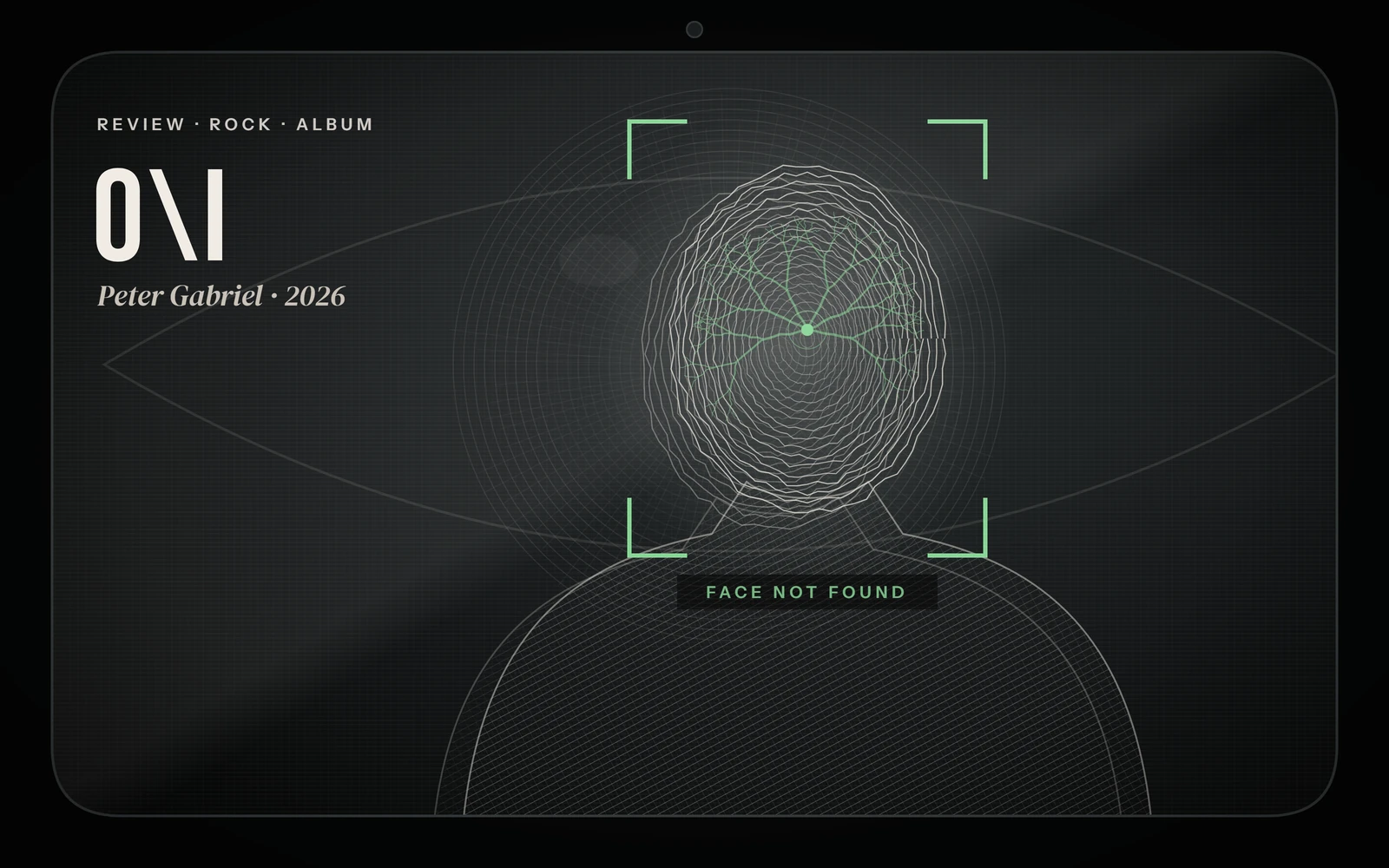
The illustration at the top of this review is our own original image, not the album's sleeve. The sleeve is a monochrome portrait by Nadav Kander, who also photographed i/o: Gabriel holds a phone up in front of his face, and the screen is filled by a single human eye, while his own face behind it is ghosted and half transparent. It is the album's question in one picture: who is looking at whom, and which of the two is more real.
We drew the reverse shot. Our view is from inside the phone, looking back out through the glass. The eye on the screen survives only as a faint mirrored reflection on the inside of the glass, and beyond it the camera finds no face at all: a ghost of contour lines, doubled like a second exposure, with a mind lit up in green where the features should be. The focus brackets lock on, and the machine reports FACE NOT FOUND. We kept the sleeve's graphite monochrome and its translucency, and added one colour, the green of the album's Bright-Side vinyl. It is the scene from "Put the Bucket Down", where thoughts can be read from outside, seen from the reader's side.
Verdict
8.0/10rock.news review score · how we score
Verdict: o\i is less a sequel to i/o than its looser, warmer twin. The big ideas, minds read by machines, the self rebuilt from pieces, death looked in the eye, arrive without panic, and the band that carries them, Katché, Levin and Rhodes with choirs, horns and an orchestra around them, plays with a freedom Gabriel has not allowed on record since Us. "I Belong to the Sky", "Who Are We Talking To?" and "A Hard Lesson" are as alive as anything he has made this century. It is too long, its lyrics have traded strangeness for wisdom, and the two-mix game asks more of a listener than most songs repay. But at 76 he has made a double album that sounds curious rather than finished, and that is rarer than it should be.
o\i came out after the window of our first-half rankings, so it is not in our rankings yet. For the year's best-rated rock records so far, see Rock 2026.
Artist page Peter Gabriel