The Funniest Sad Band in the World
A thrash band in hockey pads, a break-up album on borrowed money, a fake live record, a platinum goth hit, an autumn masterpiece, a record about death and cocaine, a fake tombstone and a real one. Our third Editor's Whim pulls the curtains and puts on Type O Negative.
 By Huginn
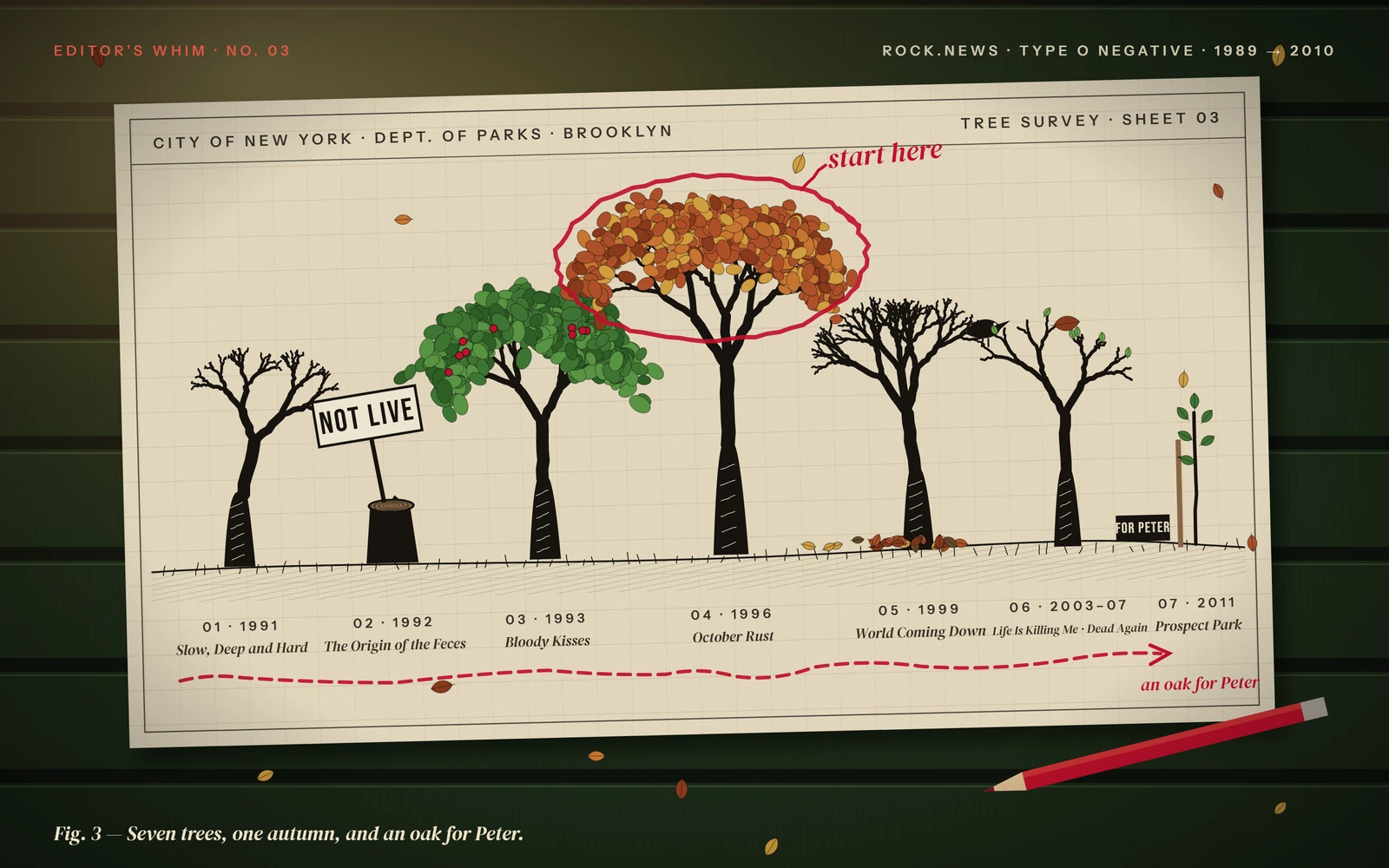
The saddest band in heavy music had a sense of humour you could hear from across the river. Four men from Brooklyn played funeral-slow songs about death, depression, guilt and lust, dressed them in church organ and Beatles harmonies, and then credited P.T. Barnum as their producer. At the front stood Peter Steele: six foot eight, a voice from the bottom of a well, a day job with the city parks and a joke ready before you could laugh at him. After Mortiis's dungeon and Alice Cooper's guillotine, our third Editor's Whim is the band that called itself the Drab Four. Turn the lights down. Not off: they would have made fun of that.
A giant from Red Hook
Peter Thomas Ratajczyk was born on 4 January 1962 in Red Hook, Brooklyn, the youngest of six children and the only boy after five sisters. He grew to six foot eight, which in a family of that shape must have settled a few arguments. He would become Peter Steele, but for years he was also a city employee: he worked for the New York City Department of Parks and Recreation, on the Brooklyn Heights Promenade among other places, and rose to park supervisor. He kept the job well into his music career, which tells you something about how much the music paid.
His first serious band, Fallout, included a keyboard player called Josh Silver. Remember the name. When Fallout split, Steele formed Carnivore in 1982, and Carnivore were something else entirely: thrash and hardcore played by men dressed as post-apocalyptic warriors, in torn clothes and spiked hockey gear, singing about nuclear war, religion and the end of civilisation with a straight face that was never entirely straight. Two albums came out, Carnivore in 1985 and Retaliation in 1987.
Carnivore were loud, fast and deliberately offensive, and the offence was the point. What matters for our story is that Steele came out of them still under contract to Roadrunner, still with that voice, and with a growing suspicion that fast was not where his songs wanted to go.
Six thousand dollars of misery
The new band started in 1989 with Silver on keyboards, Kenny Hickey on guitar and Sal Abruscato on drums. It was called Repulsion until they found out another band already was, then briefly Sub-Zero, and finally Type O Negative, after the blood group. In December 1989 they went into Systems Two in Brooklyn to record a demo. Silver borrowed $6,000 from his parents to pay for it. Roadrunner heard it and signed them.
That demo became Slow, Deep and Hard, released on 11 June 1991, and it is not an easy first date. Seven tracks run almost an hour. According to Hickey, Steele wrote most of it after a break-up, and you can tell: the opener, "Unsuccessfully Coping with the Natural Beauty of Infidelity," lasts twelve minutes and thirty-nine seconds and swings between hardcore fury, doom crawl and a mocking chant, like a man who cannot decide whether to cry, punch a wall or laugh at himself, and so does all three in order. The lyrics drew accusations of misogyny and bigotry, and it is fair to say Steele was not yet the writer he would become.
But the jokes were already there. "The Misinterpretation of Silence and Its Disastrous Consequences" is a track of hiss from a blank cassette. "Gravitational Constant" takes its riff from the theme of The Munsters. The band that would go on to soundtrack a million candle-lit bedrooms started out with a track of tape noise and a sitcom theme.
Not live at Brighton Beach
Then came the prank. The band had just survived a rough first European tour, and their answer was The Origin of the Feces, released on 12 May 1992. It presents itself as a live album from a Halloween show at Brighton Beach. It is nothing of the sort. They recorded it in the studio and added the crowd afterwards: the jeering, the banter, even a staged bomb threat, as if the audience hated them and they were enjoying it. The producer's credit reads "P.T. Barnum."
The original cover was a close-up of Steele's backside. When the album was reissued in 1994 it was replaced with a medieval Dance of Death woodcut in green and black, a rare example of a band trading toilet humour for art history and keeping the joke intact. The reissue added a slow, bruised cover of Black Sabbath's "Paranoid," first recorded for the Nativity in Black tribute and left off when Megadeth took the song.
Many bands release a fake live album as their second record in a moment of madness. Not many do it on purpose, and fewer still make it funny thirty years later. It also told everybody the key fact about Type O Negative early on: nothing they did was quite as miserable as it looked, and nothing was quite as silly as it sounded.
Melody, at last
According to Hickey, somewhere around this time Peter decided that melody was where it was at, and everything changed. Bloody Kisses, recorded at Systems Two in early 1993 and released on 17 August 1993, is seventy-three minutes of gothic doom with the hooks of a pop record and the tempo of a hearse. Silver's keyboards turn into church organ and choir; Hickey's guitars sound like they were tuned in a cellar; Steele's baritone, now properly sung, is enormous and tender at once.
"Christian Woman" is the heart of it, a slow, heavy song about desire tangled up with religion, and an edited version became a US radio hit in 1994. "Black No. 1 (Little Miss Scare-All)," named after a hair dye, is an eleven-minute portrait of a goth girlfriend that the goths loved anyway, which says a lot about everybody's sense of humour. And then there is "Summer Breeze." The band first recorded a parody called "Summer Girl"; Seals and Crofts objected, so they put the original words back and turned a soft-rock hit into a drugged-out, sludgy dream that sounds like summer seen through closed curtains.
It was the last album with the original line-up. Abruscato left at the end of 1993 to join Life of Agony, and Johnny Kelly, the band's drum tech, took his seat. Bloody Kisses kept selling: it became the first Roadrunner album certified gold in the US, in November 1995, and later the first certified platinum, in December 2000. In 1995, at the height of it, Steele posed nude for Playgirl. He later said he regretted it. We will say no more, except that the Drab Four had suddenly become a little less drab.
Autumn in Brooklyn
October Rust came out on 20 August 1996, and it is the editor's favourite: the record where the gloom turns golden. It opens with a joke, of course. "Bad Ground" is thirty-eight seconds of the buzz you get from a badly plugged lead, followed by a short spoken intro in which the band apologises for the recording. Then the curtains open, and it is the most beautiful music they ever made.
"Love You to Death" is a slow, lush love song with a riff like falling leaves, and it is the best place in the whole catalogue to fall for this band. "My Girlfriend's Girlfriend" is a jaunty, almost new-wave pop song about exactly what the title says. "Be My Druidess" is heavy and grinning; "Wolf Moon" is a werewolf song played like a seduction. "Red Water (Christmas Mourning)" is the saddest song on the album, slow and heavy and full of bells, and Black Sabbath's own Bill Ward has named it one of the best metal songs ever. Even the cover is perfect: Neil Young's "Cinnamon Girl," slowed down and drenched in organ until it sounds like it was always theirs.
It is a long record, nearly seventy-three minutes again, and there is not much hurry in it. That is the point. October Rust is an album for the first cold evening of the year, for tea, a coat on a chair and the window open a little too long. It went gold in the US, reached No. 42 on the Billboard 200 and went all the way to No. 5 in Germany and No. 3 in Sweden. Europe, as so often with gothic music, understood first.
Everything dies
Then the autumn turned to winter. World Coming Down, released on 21 September 1999, was written after a string of deaths in Steele's family, and it was made while he was deep in cocaine. The album is about both. "White Slavery" is about the drug. Three short interludes, "Sinus," "Liver" and "Lung," stand for death by cocaine, alcohol and cigarettes. "Everything Dies" and "Everyone I Love Is Dead" need no explanation, and they do not get much of one: they are huge, slow, devastated songs, sung by a man who sounds like he is standing in the cemetery, and somehow they are still catchy.
Even here the humour survives, darker than before. On "Who Will Save the Sane?" Steele recites the digits of pi. And the album closes with a medley of the Beatles' "Day Tripper," "If I Needed Someone" and "I Want You (She's So Heavy)," because Silver persuaded the label to pay for it, and because if you call yourselves the Drab Four, sooner or later you owe the Fab Four a tribute.
World Coming Down reached No. 39, the band's first US top 40, and No. 3 in Germany and Finland. It is the hardest Type O Negative album to love and the easiest to respect. It is also proof that this was never a gimmick: the gloom was real, and he wrote it down.
Midlife crisis, and a tombstone
A compilation came next, in 2000. It was called The Least Worst Of, it opened with thirty-nine seconds of silence, and its cover showed Coney Island's Parachute Jump. Then came Life Is Killing Me, released on 17 June 2003, an album about the illness and death of his parents, written by a man who said at the time that he must be having some sort of midlife crisis at 41. "Nettie" is about his mother. "I Don't Wanna Be Me" is a short, furious burst of self-loathing with a chorus you can sing in the shower. Remember that song too.
In 2004 the band left Roadrunner for SPV's Steamhammer label. In May 2005 the band's website showed a tombstone: "Peter Steele, 1962-2005." He was alive. Steele later said the idea was Silver's, a way to announce the move from Roadrunner; whoever thought of it, it was a very Type O Negative way to change labels. Real grief followed soon after. His mother died that year, and he later described it as probably the worst thing that had ever happened to him. By 2007 he said he had come back to the Catholic faith he had argued with in song for years.
Dead Again, released on 13 March 2007, opens with Rasputin on the cover and the band at full strength: seventy-seven minutes, with real drums from Johnny Kelly, the heaviest riffs since the early days and the old melodies on top. "Halloween in Heaven" is a tribute to Dimebag Darrell, killed on stage in 2004. "September Sun" is one last autumn song. It debuted at No. 27 on the Billboard 200, the best chart week of their career. It would be their last album.
Waiting for the punchline
To understand Type O Negative you have to hold two things at once, and Peter Steele held both all his life. He said openly that he had felt depressed for as long as he could remember, he talked about bipolar disorder, about drink and cocaine and what they did to his heart and liver. And he was very, very funny about it. He described himself in 2007 as an old man having his last tantrum. He liked to irritate the people who hated him. He talked about life as a long wait for the punchline. The darkness was not a costume, but the jokes were not a mask either. They were how he survived the darkness, and how the band made it bearable for the rest of us.
The punchline came on 14 April 2010. Peter Steele died in hospital in Scranton, Pennsylvania, aged 48. His death was first reported as heart failure and later attributed to sepsis. He had been ill with what seemed to be flu. He had been clean and sober for some time, and he had been talking about starting the next album. His bandmates signed a statement the next day. Johnny Kelly later put it simply: "When Peter died, Type O Negative died with him."
There was no replacement singer and there will not be one. In November 2011 an oak tree was planted for him in Prospect Park, Brooklyn. For a man who spent years looking after the city's parks, it is the right memorial.
Bigger than ever
The strange thing is what happened next. Type O Negative did not fade. The bands they opened doors for kept saying so: Ville Valo has said HIM learned to steal the best parts of Type O; Paradise Lost's Greg Mackintosh says nobody sounded like them before or since; My Dying Bride's Aaron Stainthorpe credits them with opening the doors his band walked through; Swallow the Sun's Mikko Kotamäki calls their role in the goth-doom crossover huge. You can hear them in half the dark, slow, melodic bands of the last thirty years, and in the ones you would not expect too.
Then a new generation found them, on its phones. "I Don't Wanna Be Me" went viral on TikTok, and in June 2026 the RIAA certified it gold, 500,000 units, the band's first single award, twenty-three years after release and sixteen years after the singer died. Kenny Hickey has said the band is bigger than ever, and thanked TikTok for it, which may be the most Type O Negative sentence of 2026. He is now editing a full live album, due in early 2027, and Johnny Kelly has found an unreleased October Rust track, "Prometheus," on an old cassette.
As for the men, Josh Silver trained as an EMT and became a paramedic in New York, which is a better plan B than most rock stars ever have. Hickey and Kelly play together in Sun Don't Shine. The band has been offered a lot of money for one tribute show; so far, Silver has said no. We think he is right. Some funerals are best kept small.
Where to start
Sixteen years of records, in the order the editor would play them.
Played from youtube-nocookie.com; YouTube may set cookies once the video plays. Open the playlist on YouTube · Privacy
- October Rust (1996). Start here. The editor's favourite and the band at its most beautiful. Begin with "Love You to Death," then let the whole album play.
- Bloody Kisses (1993). The breakthrough. "Christian Woman," "Black No. 1" and "Summer Breeze": gloom with hooks.
- World Coming Down (1999). The grief record. Play "Everything Dies," then "Everyone I Love Is Dead," preferably not on a Monday.
- Dead Again (2007). The last word and one of the heaviest: the title track, then "September Sun."
- Life Is Killing Me (2003). For "I Don't Wanna Be Me," the song TikTok found, and "Less Than Zero (<0)."
- Slow, Deep and Hard (1991). Rough, angry and long. Start with the twelve-minute opener and see if you survive.
- The Origin of the Feces (1992). For the joke, and for "Paranoid" played like a hangover.
- Deep cut: "Red Water (Christmas Mourning)" (October Rust). The saddest song they ever recorded and maybe the most beautiful. Save it for a cold December night, alone, with the lights low.
Verdict: Type O Negative should have been a novelty. A thrash bruiser from Carnivore singing slow love songs over church organ, a fake live album, a backside on the cover, a tombstone on the website: on paper it is a joke band. Instead they invented a sound, gothic doom with pop hooks and a Brooklyn accent, that whole scenes still live in, and they made four records, from Bloody Kisses to World Coming Down, that sound as good in 2026 as they did on the day. Underneath the jokes there was a giant who felt everything too much and said so, and who found a way to make sadness warm, sexy and even funny. Few bands make you laugh and grieve in the same song. Put on October Rust, open the window a little, and wait for the punchline. It is worth it.
Sources and further reading
- Wikipedia: "Peter Steele", "Type O Negative", "Carnivore (band)", "Josh Silver", "Slow, Deep and Hard", "The Origin of the Feces", "Bloody Kisses", "October Rust", "World Coming Down", "The Least Worst of Type O Negative", "Life Is Killing Me", "Dead Again (Type O Negative album)".
- Metal Hammer (Louder): Peter Steele interview, March 2007; the story of Bloody Kisses; musicians on Type O Negative's influence.
- Loudwire: Peter Steele's death and the band's memories.
- Chaoszine: Ville Valo on Type O Negative (May 2022).
- Blabbermouth: "I Don't Wanna Be Me" certified gold (June 2026); Kenny Hickey on TikTok and the live album (October 2026); the tribute show offer (November 2026); the 2005 tombstone.
Editor's Whim is the editor's personal pick: no rankings, no data, just an artist we think deserves your evening. Next in the series: Tool. Meanwhile, go down into Mortiis's dungeon or take a seat in the front row with Alice Cooper, the nicest villain in rock.
Artists in this piece Type O Negative, Carnivore, Alice Cooper, Black Sabbath, Mortiis, The Beatles, HIM, Life of Agony, Megadeth, My Dying Bride, Neil Young, Paradise Lost, Seals and Crofts, Swallow the Sun